
The refinery I most often visit on the large oil and gas mega-project in Asia isn’t technically a refinery — it’s the gas processing and treatment side of an integrated complex. But the process control challenges are the same ones that define refining everywhere: continuous operation under tight quality specifications, dozens of interconnected unit operations, thousands of control loops working together, safety systems that must function flawlessly during upsets, and a control room that operates 24/7 across multiple operator shifts.
The Honeywell Experion DCS we run handles all of it, in essentially the same way a refinery DCS handles its much larger and more complex process.
Walking through a real refinery control room is a particular experience for anyone who’s spent time in process control. Twenty or thirty operator workstations arrayed in rows, each operator responsible for a specific unit — the crude unit, the FCC, the hydrocracker, the reformer, utilities.
Banks of large screens showing process overviews. The constant low hum of HVAC and the subtle background noise of conversations between operators and field technicians. Behind the operators, supervisors and engineers watching multiple screens. This is what large-scale process control actually looks like, and it’s the DCS that makes it possible.
This guide is the practitioner explanation of DCS in refining that I wish I’d had when I first started understanding why petroleum refineries are the largest DCS deployments in the world. I’ll walk through every major refinery unit and what its DCS challenges actually are, the critical control loops that define refinery operations, safety system integration, advanced process control, and the brownfield migration realities that dominate refinery DCS work in 2026.
If you’ve read our What Is a DCS cornerstone guide, this article shows how all those architectural concepts come together in the most demanding industrial process control application that exists.
TL;DR — Quick Answer: What Is DCS in Refining?
DCS in refining refers to the application of Distributed Control Systems to petroleum refinery operations — the continuous control of crude oil distillation, conversion units (FCC, hydrocracker, coker), treating units (hydrotreaters, sulfur recovery), and product blending across the integrated facility. Refining is the largest single application domain for DCS technology, with major refineries deploying 20,000 to 50,000+ I/O points across multiple control rooms.
The DCS in a refinery handles continuous process control across all major units, integrates with safety instrumented systems (SIS) for emergency shutdown, supports advanced process control (APC) and real-time optimization (RTO), provides operator interfaces designed to ISA-101 standards, manages alarm systems per ISA-18.2, and connects to enterprise systems per ISA-95.
The major DCS platforms in refining are Honeywell Experion PKS, Yokogawa CENTUM VP, Emerson DeltaV, ABB 800xA, and Siemens PCS 7 — with regional variations in market share. Refinery DCS deployments typically last 25-30 years between major platform migrations, with continuous expansion, upgrades, and unit modifications throughout the lifecycle.
Key concepts for refinery DCS:
- Continuous 24/7 operation between turnarounds (typically 4-5 year intervals)
- Massive I/O scale — 20,000-50,000+ tags across an integrated refinery
- Multiple operator stations — typically one per major unit, with dedicated control rooms
- Heavy use of advanced control — cascade, feedforward, override, RTO, multivariable predictive control
- Integrated SIS — emergency shutdown systems for furnaces, towers, compressors
- Real-time optimization — economic decisions made continuously based on margin
- Brownfield reality — most refinery DCS work in 2026 is migration, not greenfield
What You Will Learn
This guide covers DCS in refining at practitioner depth:
- Why refining is the largest DCS deployment domain in the world
- The major refinery units and the specific DCS challenges of each (CDU, VDU, FCC, hydrocracker, reformer, hydrotreaters, coker, alkylation, utilities)
- The critical control loops that define refinery operations
- Safety instrumented systems in refining and how they integrate with DCS
- Advanced Process Control (APC) and real-time optimization (RTO) integration
- DCS platform considerations for refinery applications
- The brownfield migration reality that dominates refinery DCS work
- Common refinery DCS implementation mistakes I’ve seen
Why Refining Is the Largest DCS Deployment Domain
Petroleum refining is the largest single application domain for DCS technology in the world. Understanding why explains a lot about DCS architecture and engineering.
DCS in refining scale.
A major integrated refinery processing 200,000+ barrels of crude per day typically operates with tens of thousands of I/O points across the DCS. The largest integrated refining and petrochemical complexes can exceed 100,000 I/O on their combined control systems. No other industry routinely deploys at this scale.
DCS in refining continuity.
A refinery runs continuously between scheduled turnarounds, typically 4-5 years. During that time, the DCS must operate without unplanned downtime. The cost of an unplanned shutdown of a major refinery unit can run into millions of dollars per day in lost margin. The reliability, redundancy, and lifecycle support requirements that drive DCS architecture come directly from refining’s economic reality.
DCS in refining complexity.
A refinery integrates 10-15 distinct unit operations, each with different process chemistry, different control challenges, and different operating envelopes. The DCS must coordinate all of these as one continuous process — crude feed entering the atmospheric distillation column eventually becomes gasoline at the blending station, with dozens of transformations along the way.
Safety criticality.
Refining operates at high temperatures (up to 1,100°F in coker reactors), high pressures (up to 3,000 psig in hydrocracker reactors), with hydrocarbons that range from highly volatile to extremely toxic. The DCS doesn’t directly enforce safety — that’s the SIS’s job — but the DCS provides the continuous control that keeps the process within safe operating boundaries.
Economic value at stake.
Refining margins (the difference between crude purchase cost and product sale prices) are measured in dollars per barrel. A 1% improvement in product yield at a 200,000 bpd refinery is worth tens of millions of dollars annually. The DCS, combined with advanced process control and real-time optimization, is what captures that economic value.
Understanding DCS in refining requires understanding both the platform technology and the refinery-specific application reality. For broader DCS context, see our What Is a DCS cornerstone guide.
The Major Refinery Units and Their DCS in Refining Challenges
DCS in refining covers every major unit operation. Every refinery has its own configuration, but most major refineries include a similar set of unit operations. Each unit has its own DCS challenges. Here’s the practical breakdown.
Crude Distillation Unit (CDU) — The Foundation Unit.
The atmospheric distillation column separates crude oil into fractions by boiling point — light naphtha, heavy naphtha, kerosene, diesel, atmospheric gas oil, atmospheric residue. The CDU is typically the largest unit in the refinery by feed volume and the foundation that everything else depends on.
DCS challenges in the CDU:
- Furnace outlet temperature control — the crude must enter the column at precisely the right temperature for clean fractionation. Too cold and product separation is poor; too hot and thermal cracking starts. This is a classic cascade control loop (furnace outlet temp master controlling fuel gas flow slave).
- Column pressure control — maintained tightly to ensure product specifications
- Tray temperature profiles — multiple temperature measurements across the column height; product draw rates adjusted based on tray temperatures
- Product specifications — each draw cut (naphtha, kerosene, diesel) has specific gravity, sulfur, and distillation specs that the operator must hit continuously
- Side stripper control — small columns attached to the main column that strip light ends from product cuts
A modern CDU typically has 2,000-4,000 I/O points on its dedicated DCS controllers.
Vacuum Distillation Unit (VDU) — Further Separation.
The atmospheric residue from the CDU feeds the vacuum column, which separates under reduced pressure (allowing higher temperature separation without thermal cracking). Products are light vacuum gas oil (LVGO), heavy vacuum gas oil (HVGO), and vacuum residue.
DCS challenges in the VDU:
- Vacuum control — typically maintained by steam ejectors or vacuum pumps; precise control is essential for clean separation
- Furnace coil temperatures — VDU furnaces have multiple coils; balance between coils is critical for tube life
- Quench oil systems — preventing coke formation in transfer lines and column bottoms
- Heavy product handling — vacuum residue requires heated lines and tanks
VDU typically adds 1,500-2,500 I/O to the DCS.
Fluid Catalytic Cracker (FCC) — The Conversion Workhorse.
The FCC converts heavy vacuum gas oil into gasoline, diesel, and lighter products through catalytic cracking. The reactor operates with a fluidized catalyst bed at high temperatures (900-1,000°F). The regenerator burns coke off the catalyst to provide reaction heat. FCC is typically the most complex single unit in a refinery.
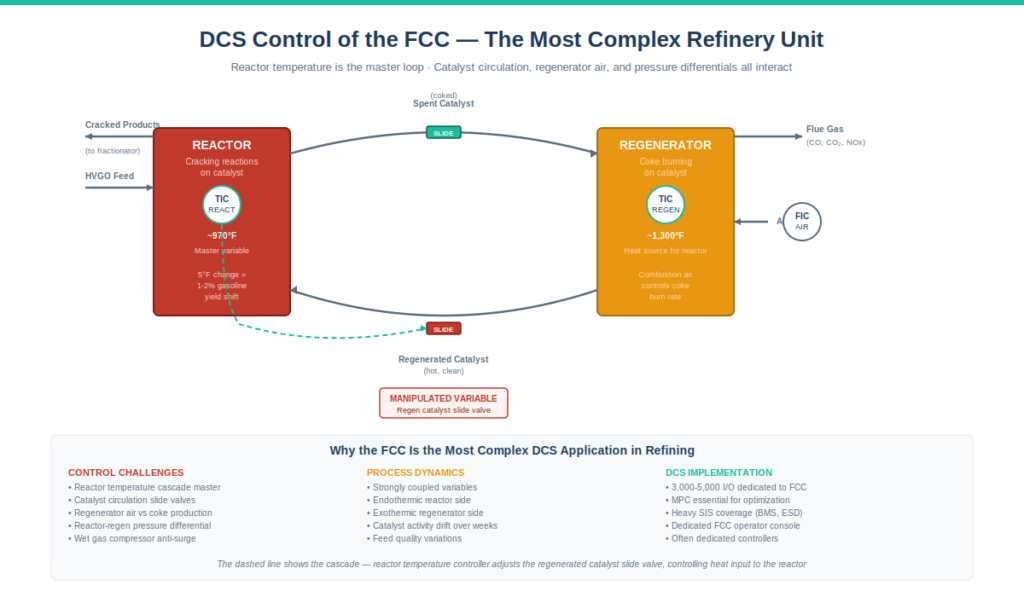
DCS in refining is most challenging in the FCC. DCS challenges in the FCC are substantial:
- Reactor temperature control — the master variable controlling conversion. Implemented as cascade (feed temperature controlling slide valve position)
- Catalyst circulation control — slide valves between reactor and regenerator must balance catalyst flow against pressure differential
- Regenerator air control — combustion air for coke burning; must match coke production rate
- Riser temperature — affects catalyst-to-oil ratio and product distribution
- Differential pressure control — between reactor and regenerator; critical to prevent catalyst loss
- Wet gas compressor surge protection — the compressor handling FCC overhead products has tight anti-surge control requirements
- Fractionator control — the main distillation column downstream of the reactor
The FCC alone typically requires 3,000-5,000 I/O. Many refineries use dedicated controllers for the FCC because of its complexity and criticality. The 2015 Torrance refinery FCC explosion was a sobering reminder that FCC safety depends on impeccable control system performance.
Hydrocracker — Heavy Conversion with Hydrogen.
The hydrocracker converts heavy oils (HVGO, sometimes atmospheric residue) into lighter products by cracking under high hydrogen pressure. Reactor pressures of 1,500-3,000 psig and temperatures of 700-800°F. Multi-bed reactors with quench gas between beds to control temperature rise.
DCS challenges in the hydrocracker:
- Weighted Average Bed Temperature (WABT) — the master control variable; calculated continuously from multiple bed temperature measurements
- Quench gas control — hydrogen injection between beds to control temperature rise from exothermic reactions
- Hydrogen partial pressure control — affects catalyst life and product quality
- Recycle gas compressor control — high-pressure hydrogen recycle; surge protection is critical
- Cold separator level and pressure control — separating hydrogen for recycle from liquid products
- Temperature runaway protection — if temperature control fails, exothermic runaway can damage the catalyst and reactor
Hydrocrackers typically add 4,000-6,000 I/O. Because of the safety criticality, hydrocrackers often have extensive SIS coverage integrated with the DCS.
Catalytic Reformer — Octane Generation.
The reformer converts naphtha into high-octane reformate (gasoline blending stock) through catalytic reactions. Two main configurations: semi-regenerative (cycle catalyst regeneration during turnarounds) and continuous catalyst regeneration (CCR — modern continuous regeneration during operation).
DCS challenges in the reformer:
- Reactor temperature control — multiple reactors in series with intermediate furnaces (interheaters)
- Hydrogen-to-hydrocarbon ratio control — implemented with ratio control loops
- CCR catalyst circulation control — for continuous regeneration units, the catalyst transport system requires careful monitoring
- Recycle gas compressor control — hydrogen recycle similar to hydrocracker
Reformers typically add 2,000-4,000 I/O.
Hydrotreaters — Sulfur and Nitrogen Removal.
Hydrotreaters remove sulfur, nitrogen, and other contaminants from product streams using hydrogen and catalyst. Each refinery typically has multiple hydrotreaters — naphtha hydrotreater, kerosene hydrotreater, diesel hydrotreater, FCC feed hydrotreater. ULSD (ultra-low sulfur diesel) compliance has made hydrotreating increasingly important.
DCS challenges in hydrotreaters:
- Reactor temperature control with bed quenching similar to hydrocracker
- Hydrogen partial pressure for desulfurization effectiveness
- Recycle gas compressor control
- Product specifications — sulfur content must meet ULSD or other product specs continuously
Each hydrotreater typically adds 1,000-2,000 I/O. A refinery with 5-6 hydrotreaters adds 5,000-12,000 I/O for that function alone.
Delayed Coker — Heavy Residue Conversion.
The delayed coker takes vacuum residue and converts it through thermal cracking. The “delayed” refers to the practice of preheating the residue and dumping it into a large insulated coke drum where the cracking happens over hours. Product is coke (solid carbon), gas oil, naphtha, and gas.
DCS challenges in the coker:
- Furnace coil temperature — preheating residue to thermal cracking temperatures (900-950°F)
- Drum cycle management — typically two parallel coke drums alternating between filling, cooling, and decoking phases
- Steam stripping control — at end of fill cycle to recover hydrocarbons before decoking
- High-pressure water decoking — sequencing the decoking water blast through automated valve sequences
Cokers typically add 1,500-2,500 I/O. The coke drum cycle sequencing is one of the more complex sequence control challenges in refining.
Alkylation Unit — Octane Synthesis.
The alkylation unit reacts isobutane with light olefins to produce alkylate (high-octane gasoline blending stock). Two technology types: HF (hydrofluoric acid) alkylation and sulfuric acid alkylation. Both involve hazardous chemistries that require extensive safety control.
DCS challenges in alkylation:
- Acid concentration control — critical to product quality and unit safety
- Reactor temperature control — affects product octane
- Refrigeration control — alkylation operates at low temperatures
- HF or sulfuric acid handling — extensive safety interlocks
Alkylation units typically add 1,500-2,500 I/O with extensive SIS coverage.
Utilities and Offsites.
Beyond the process units, refineries have extensive utility systems — steam generation (typically 2-4 boilers), cooling water, instrument air, electrical distribution, flare systems, tank farms, product blending. These add another 5,000-15,000 I/O depending on facility complexity.
Critical Control Loops in a Refinery
Some DCS in refining control loops define operations. These are the loops where DCS performance directly affects refinery economics and safety.
Furnace outlet temperature loops.
Every major refinery unit has a furnace upstream — CDU charge furnace, VDU furnace, FCC feed preheater, hydrocracker charge heaters, reformer charge heaters, coker heater. Each furnace outlet temperature is a critical control loop, typically implemented as cascade with fuel gas as the manipulated variable.
Furnace control involves:
- Master loop: Outlet temperature controlled by manipulating fuel gas flow setpoint
- Slave loop: Fuel gas flow controller manipulating control valve
- Air/fuel ratio: Typically ratio control or oxygen feedback
- Burner management system (BMS): SIS-rated interlocks protecting against unsafe combustion conditions
For the deep treatment of cascade control as applied in refining furnaces, see our Cascade Control guide.
Column pressure and temperature profiles.
Distillation columns are the workhorses of refining. Every refinery has dozens of columns — main CDU column, VDU column, FCC main fractionator, hydrocracker fractionator, reformer stabilizer, debutanizer, dehexanizer, splitter columns. Each column has:
- Pressure control — maintained tightly through overhead condenser cooling
- Tray temperature profile — measured at multiple points; defines product quality
- Product draw flow rates — based on temperature and downstream demand
- Reboiler steam flow — provides separation energy
Column control is where PID tuning discipline directly affects product quality and energy consumption.
FCC reactor temperature.
The FCC reactor temperature is one of the most economically important control loops in any refinery. A 5°F change in reactor temperature can shift gasoline yield by 1-2%. Implemented as cascade with the catalyst regenerated slide valve as the manipulated variable, the loop must respond quickly to feed rate changes, feed quality changes, and catalyst activity changes.
Hydrocracker WABT.
Weighted Average Bed Temperature is the master variable for hydrocracker control. Calculated continuously from multiple bed temperature measurements, weighted by catalyst volume. Operating temperature is adjusted to maintain product specifications while managing catalyst life. WABT control involves feedforward elements to compensate for feed quality variations.
Compressor anti-surge protection.
Every major refinery has multiple large compressors — FCC wet gas compressor, hydrocracker recycle gas compressor, reformer recycle gas, hydrogen makeup compressors. Each requires anti-surge control to prevent compressor damage during low-flow or high-pressure conditions. Surge control is typically implemented as override loops with override controllers ensuring minimum flow.
Tank and inventory control.
Refineries operate with extensive tank farms — crude tanks, intermediate product tanks, finished product tanks. Tank level control, transfer scheduling, and product blending coordination are all DCS responsibilities, often integrated with Level 3 MES systems for production accounting and inventory management.
Safety Instrumented Systems in Refining
DCS in refining must integrate with extensive safety systems. Refineries are among the most safety-critical industrial environments. The SIS in a refinery handles thousands of safety functions across all units. For deep SIS context, see our Safety Instrumented System guide.
Refinery-specific SIS applications:
- Burner Management Systems (BMS) — protecting against unsafe furnace combustion conditions. Typically SIL 2 or SIL 3. Every furnace has its own BMS.
- Emergency Shutdown Systems (ESD) — unit-level shutdown for major upsets. Typically SIL 2. Operator-initiated or automatic on critical conditions.
- High Integrity Pressure Protection Systems (HIPPS) — protecting against overpressure on hydrocracker reactors, hydrogen plant systems, etc. Typically SIL 3.
- Fire and Gas Detection — distributed flame detectors, gas detectors, and manual call points throughout the refinery. SIL 2 or higher depending on hazard.
- Pressure relief device monitoring — ensuring relief valves and rupture discs are operational
- Anti-surge final element trip — protecting compressors when anti-surge control alone is insufficient
The SIS platforms common in refining are Honeywell Safety Manager (with Experion), Yokogawa ProSafe-RS (with CENTUM), Triconex (vendor-independent), and Emerson DeltaV SIS (with DeltaV).
HAZOP and SIL assessment.
Every refinery unit undergoes formal HAZOP (Hazard and Operability) studies and SIL (Safety Integrity Level) assessment during design and after major modifications. These are weeks-long workshops with operations, engineering, safety, and vendor specialists working through every safety scenario.
Advanced Process Control (APC) Integration
Beyond basic regulatory control (PID loops), DCS in refining integrates with Advanced Process Control (APC) and Real-Time Optimization (RTO) systems that capture significant economic value.
Multivariable Predictive Control (MPC).
MPC controllers (Honeywell Profit Controller, AspenTech DMC3, Yokogawa Robust MPC, Emerson DeltaV PredictPro) sit above the DCS and handle multivariable optimization across complex units. The MPC adjusts DCS setpoints based on a process model and economic objective function — pushing the unit toward optimal economics within constraint boundaries.
Typical MPC applications in refining:
- FCC main fractionator — optimizing product distribution
- Crude unit operation — maximizing valuable product yields
- Hydrocracker — balancing severity, hydrogen consumption, catalyst life
- Reformer — optimizing octane and hydrogen production
- Hydrotreater — balancing severity and product specs
A well-tuned MPC typically captures 2-5% economic benefit beyond basic DCS control. Across a major refinery, that translates to tens of millions of dollars annually.
Real-Time Optimization (RTO).
RTO systems sit above MPC and adjust MPC objectives based on real-time market prices, feedstock costs, and demand patterns. The RTO solves a plant-wide optimization problem (typically every few hours) and pushes optimal setpoints down through MPC to the DCS.
Inferential property modeling.
Many product properties (density, distillation cuts, octane number, cetane index) can’t be measured continuously — they require lab analysis. Inferential models predict these properties from continuous DCS measurements (temperatures, pressures, flow rates) and update the predictions in real-time. The DCS uses these inferred values for closed-loop control, with periodic correction from actual lab samples.
DCS Platform Considerations for Refining
Each major DCS platform has strengths and weaknesses for DCS in refining applications. After working across multiple platforms, here’s the honest comparison.
Honeywell Experion PKS.
Strong in refining historically — Honeywell has deep refining expertise from its TDC2000/TDC3000 legacy and continuing development. The Experion + Safety Manager combination is widely deployed in major refineries. Honeywell Profit Suite for APC and RTO integrates natively with Experion. The unified platform model reduces multi-system integration complexity.
For broader Experion context, see our Honeywell Experion PKS architecture guide.
Yokogawa CENTUM VP.
Strong in refining particularly in Japan, Southeast Asia, and the Middle East. The distributed database architecture handles refinery scale well. CENTUM + ProSafe-RS native integration is mature. Yokogawa’s APC offerings include Robust MPC and OmegaLand simulation.
For broader CENTUM context, see our Yokogawa CENTUM VP architecture guide.
Emerson DeltaV.
DeltaV is more common in petrochemicals than mainline refining historically, though Emerson has been expanding refinery presence. CHARMs I/O technology can simplify large I/O counts. DeltaV SIS native integration. Emerson’s APC offerings include AspenTech (now Aspen Technology) partnerships for DMC3.
For broader DeltaV context, see our Emerson DeltaV architecture guide.
ABB 800xA and Siemens PCS 7.
Both have refinery deployments, though smaller market share in refining specifically than Honeywell, Yokogawa, and DeltaV. Strong in petrochemicals adjacent to refining (ethylene crackers, olefins).
The Brownfield Migration Reality
Most DCS in refining work in 2026 is not greenfield — it’s brownfield migration. Existing refineries built on TDC3000, CENTUM CS3000, or older PROVOX systems must migrate to modern platforms while continuing to operate. This is some of the most challenging DCS engineering work in the industry.
Typical migration scenarios:
- TDC3000 to Experion PKS — Honeywell’s installed base migrating within the family
- CENTUM CS3000 to CENTUM VP — Yokogawa’s installed base migrating within the family
- PROVOX to DeltaV — Emerson’s installed base migrating to modern platform
- Cross-vendor migrations — sometimes refineries switch vendors during major modernization
Migration constraints:
- No unplanned downtime tolerance — migration must happen during planned turnarounds (typically every 4-5 years)
- Limited turnaround windows — typical turnaround is 30-60 days; migration must fit within
- Operations continuity — operators must be trained on new platform before cutover
- Historical data preservation — historian data, alarm history, configuration changes spanning years
- Field instrumentation reuse — most existing field wiring and instruments stay; only the DCS changes
- Integration with existing SIS, APC, and MES — surrounding systems often remain on legacy platforms
Phased migration strategy.
Large refinery migrations typically happen in phases over multiple turnarounds:
- Migrate non-critical units first (utilities, offsites)
- Migrate one process unit per turnaround
- Mixed operation with old and new DCS running in parallel for years
- Final consolidation when last legacy unit migrates
A complete refinery DCS migration can take 7-10 years from project initiation to final legacy decommissioning.
For the broader architectural decision context, see our DCS vs SCADA vs PLC capstone guide.
Common Refinery DCS Mistakes I’ve Seen
After working on oil and gas EPC projects with refinery-adjacent operations, here are the recurring mistakes I see in DCS in refining work:
Underestimating brownfield complexity. Greenfield engineering teams underestimate the constraints of brownfield DCS in refining migrations. Existing wiring, existing operator habits, existing alarm philosophies, existing APC tuning — all of these constrain the migration in ways that aren’t apparent from the design drawings. Budget more engineering time than your initial estimate.
Skipping HMI rationalization during migration. Migrating old screens directly to a new platform preserves all the bad design decisions from 20 years ago. Migration is the right time to rebuild HMI graphics to ISA-101 standards. Skipping this means operators continue suffering through poor HMI design after spending millions on platform migration.
Carrying forward alarm philosophy from legacy systems. Same logic applies to alarms. Legacy refineries typically have thousands of alarms that have never been honestly questioned. Migration is the right time to rationalize per ISA-18.2. Skipping this carries forward decades of alarm noise.
Treating SIS as DCS afterthought. SIS is its own discipline with its own engineering, validation, and commissioning sequence. Refinery SIS work — burner management systems, ESDs, HIPPS — deserves dedicated engineering effort, not folding into DCS commissioning as a secondary task.
Underestimating APC re-tuning effort. When DCS migrates, all the existing APC tuning may need re-validation against the new platform’s response characteristics. Failing to plan for APC re-commissioning means losing the economic benefit captured by years of APC tuning.
Insufficient operator training. Operators have been running the legacy system for decades. Cutover to a new platform requires substantial training before commissioning. Trying to train operators after cutover causes operational problems and erodes confidence in the new platform.
Ignoring cybersecurity integration. Modern DCS in refining deployments are network-connected to enterprise systems, vendor remote support, and increasingly to cloud analytics. IEC 62443 zones and conduits must be designed in, not bolted on after migration.
Treating utilities and offsites as second-class. Boilers, cooling water, instrument air, flare systems — these aren’t glamorous but they’re essential to refinery operation. Underinvesting in utility DCS quality creates cascading problems across the entire refinery.
Skipping cause-and-effect validation during migration. Cause-and-effect matrices that worked correctly on the legacy SIS may behave differently on the new platform due to I/O scaling differences, timer behaviors, or communication latencies. Re-validate every C&E during commissioning.
Forgetting the alarm management lifecycle. ISA-18.2 lifecycle doesn’t end at commissioning. Refineries that don’t continuously monitor alarm performance and conduct periodic rationalization drift back to alarm overload within a few years.
Underestimating change management. Refinery DCS changes during operation (between turnarounds) must follow strict management of change. Casual setpoint adjustments, alarm changes, or interlock modifications without formal MOC create undocumented changes that cause problems years later.
Frequently Asked Questions
What is DCS in refining?
DCS in refining refers to the application of Distributed Control Systems to petroleum refinery operations — continuous process control across crude distillation, conversion units (FCC, hydrocracker, coker), treating units (hydrotreaters), and utilities. Major refineries deploy 20,000-50,000+ I/O points on integrated DCS platforms with safety system integration, advanced process control, and enterprise system connectivity.
Which DCS platforms are used in refining?
The major DCS platforms in refining are Honeywell Experion PKS, Yokogawa CENTUM VP, Emerson DeltaV, ABB 800xA, and Siemens PCS 7. Market share varies by region — Honeywell and Yokogawa are particularly strong in refining globally; DeltaV is more common in petrochemicals; ABB and Siemens have refinery deployments but smaller market share in mainline refining.
How many I/O points does a typical refinery DCS have?
A small to mid-size refinery typically operates with 10,000-20,000 I/O points on its DCS. Large integrated refineries (200,000+ bpd) typically have 20,000-50,000 I/O. The largest mega-refineries (Jamnagar, Ulsan, Ras Tanura) exceed 100,000 I/O across their integrated control systems.
What are the most critical control loops in a refinery?
The most economically and operationally critical loops include: furnace outlet temperatures (CDU, VDU, FCC feed preheater, hydrocracker heaters, reformer heaters), FCC reactor temperature, hydrocracker Weighted Average Bed Temperature (WABT), distillation column tray temperatures and pressures, compressor anti-surge protection, and tank inventory control. Each of these directly affects refinery economics and safety.
What is APC in refining?
Advanced Process Control (APC) in refining refers to multivariable predictive control (MPC) and real-time optimization (RTO) systems that sit above the basic DCS PID control. APC manipulates DCS setpoints based on economic objectives, capturing 2-5% economic improvement beyond basic regulatory control. Common APC platforms include Honeywell Profit Suite, AspenTech DMC3, Yokogawa Robust MPC, and Emerson PredictPro.
How long does a refinery DCS last?
A refinery DCS platform typically operates for 25-30 years between major platform migrations. During that time, individual controllers and I/O modules are replaced as they fail or become obsolete, but the platform itself (Experion, CENTUM, etc.) remains. Migration to a new platform is a major project typically planned during refinery turnarounds.
What is the difference between refinery DCS and petrochemical DCS?
The core DCS technology is the same — refining and petrochemicals use the same Experion, CENTUM, DeltaV, or 800xA platforms. The differences are in the specific unit operations and control challenges. Refining is dominated by distillation, catalytic conversion, and treating; petrochemicals add reactor systems, polymerization, and specialty chemicals operations. DeltaV has historically been stronger in petrochemicals; Experion and CENTUM have been stronger in mainline refining.
For the third sibling application — pharmaceutical batch manufacturing under FDA 21 CFR Part 11, EU Annex 11, and GAMP 5 validation, where ISA-88 batch control replaces continuous process control and DeltaV and PCS 7 dominate the vendor landscape — see our DCS in Pharmaceutical guide
For the closest sibling application — cryogenic process control in LNG plants where the same DCS technology applies to natural gas liquefaction at -160°C with the Main Cryogenic Heat Exchanger as the defining equipment and Yokogawa CENTUM among the most widely deployed platforms on liquefaction trains — see our DCS in LNG guide.
Are refineries moving to cloud DCS?
The core process control layer (Levels 1-2 in the Purdue model) stays on-premise for determinism and cybersecurity reasons. However, refineries are increasingly moving Level 3-4 systems (historians, analytics, MES, ERP) to cloud platforms. Hybrid architectures with on-premise control and cloud analytics are becoming the modern standard.
How does refinery DCS integrate with enterprise systems?
Refinery DCS connects to enterprise systems (production accounting, inventory management, financial reporting, supply chain) through the Level 3 layer per the ISA-95 model. Historian data, batch records, production performance, material consumption, and quality data flow upward from the DCS to MES and ERP through B2MML or vendor-specific protocols. See our ISA-95 Enterprise Integration guide for the complete framework.
What standards apply to refinery DCS?
Refinery DCS implementation references multiple standards: ISA-101 for HMI design, ISA-18.2 for alarm management, ISA-95 for enterprise integration, IEC 61511 for functional safety, IEC 62443 for cybersecurity, and API (American Petroleum Institute) standards for refinery-specific safety and equipment requirements.
Conclusion
Petroleum refining is the largest and most demanding application domain for distributed control systems in the world. The combination of scale (20,000-100,000+ I/O), continuity (continuous operation between 4-5 year turnarounds), complexity (10-15 interconnected unit operations), safety criticality (high temperatures, high pressures, hazardous chemistries), and economic value (refinery margins measured in dollars per barrel) creates engineering challenges that drive the entire DCS industry.
The most important practical truths about DCS in refining:
- DCS in refining drives scale, reliability, and lifecycle support requirements across the industry
- Every major refinery unit has distinct control challenges that the DCS must handle
- Critical DCS in refining control loops (furnace outlet temperatures, FCC reactor temperature, hydrocracker WABT) directly affect refinery economics
- Safety instrumented systems handle thousands of safety functions across all units
- Advanced process control captures 2-5% economic benefit beyond basic DCS control
- Most DCS in refining work in 2026 is brownfield migration, not greenfield
- Migration is the right time to rebuild HMI design to ISA-101 and rationalize alarms to ISA-18.2
On every oil and gas mega-project I’ve worked on, the same fundamental DCS in refining principles that apply to refining apply to upstream and midstream operations — continuous control, integrated safety, advanced process control, enterprise integration, ISA standards compliance, and lifecycle discipline. The scale is different; the principles are the same.
If you’re approaching a DCS in refining project, resist the temptation to treat it as just a larger version of a smaller process. The scale changes engineering effort, vendor coordination, operations team integration, and lifecycle management in fundamental ways. Plan for it explicitly. And recognize that refinery DCS is a 25-30 year commitment that pays back through decades of continuous operation, not a one-time delivery.
Understanding DCS in refining requires understanding both the platform technology and the refinery-specific application reality. For broader DCS context, see our What Is a DCS cornerstone guide. For platform-specific implementation, see our Honeywell Experion PKS architecture guide, Yokogawa CENTUM VP architecture guide, and Emerson DeltaV architecture guide.
For control theory underlying refinery loops, see our PID Tuning Methods guide, Cascade Control guide, Feedforward Control guide, and Ratio Control guide.
For safety and standards context, see our Safety Instrumented System guide, ISA-101 HMI Design guide, ISA-18.2 Alarm Management guide, and ISA-95 Enterprise Integration guide.
About the Author
Daniel Reed is an Instrument and Controls Engineer with 14+ years of oil and gas EPC experience across onshore and offshore projects in Asia and Africa. He currently works as a client-side I&C completion engineer on a large oil and gas mega-project in Asia, where he has been involved with Honeywell Experion PKS and Safety Manager since 2018.
His earlier work covered Yokogawa CENTUM and Triconex SIS on an offshore brownfield in Africa (2015-2018), and Yokogawa CENTUM and ProSafe-RS on a gas-to-liquids facility in Africa. His focus is engineering deliverable review, control and safety system commissioning, HAZOP/SIL/SIF participation, FAT/SAT execution, and vendor coordination across Honeywell, Yokogawa, Triconex, Allen-Bradley, and Siemens platforms.