
The first time I worked on an EPC project where the wrong control system was chosen, it cost the operator about six months of delayed startup and a complete control system replacement. The project was a medium-sized gas processing facility — three trains, around 8,000 I/O tags, continuous operation, integrated safety systems. The original design specified a PLC-based architecture with SCADA on top because the EPC contractor was more comfortable with PLCs and the initial CAPEX was lower.
By the time the system was being commissioned, the limitations were obvious: alarm management was fragmented across multiple SCADA stations, the historian couldn’t keep up with the I/O rate, integration with the safety system was awkward, and operations refused to accept the HMI because it didn’t behave like the DCS systems they were trained on. The system was replaced with Honeywell Experion PKS before the plant ever produced sellable product.
That experience taught me something important about the DCS vs PLC question. It isn’t really about which technology is “better” — both are mature, capable, and reliable when applied correctly. The question is whether the architecture matches the process, the operations team, and the lifecycle expectations of the plant. Get this right and the plant runs for 25 years with minimal control system grief. Get it wrong and you pay the difference for the life of the asset.
This guide walks through the DCS vs PLC question from the perspective of an engineer who has worked extensively in both worlds. I started my career in PLC environments — Allen-Bradley, Siemens, Modicon — before moving into DCS work on oil and gas EPC projects. I now maintain a PLC-focused resource at controlsystemguide.com and the DCS-focused resource you’re reading. The cross-vendor, cross-architecture perspective is what shapes this article.
If you’ve read our What Is a DCS cornerstone guide, this article builds on those foundations to clarify the architectural choice that drives most of the lifecycle cost on industrial control projects.
TL;DR — Quick Answer: DCS vs PLC
The fundamental difference between DCS vs PLC is not the controllers themselves but the architectural philosophy. A DCS (Distributed Control System) is an integrated, vendor-supplied package combining controllers, operator interface, engineering tools, historian, alarm management, and often safety systems — all designed to work together for continuous process control across thousands of I/O points.
A PLC (Programmable Logic Controller) is a single controller, originally designed for discrete machine control, that has evolved into highly capable hardware suitable for many process applications when combined with separately-procured HMI, historian, and SCADA software.
The practical answer to DCS vs PLC depends on scale, process type, redundancy requirements, and lifecycle considerations:
- Choose DCS for continuous processes with 2,000+ I/O, multiple operator stations, integrated safety systems, and a 20-30 year lifecycle expectation. Refineries, gas plants, petrochemical facilities, power stations, and pharmaceutical batch plants are predominantly DCS.
- Choose PLC + SCADA for discrete manufacturing, small process applications under 500 I/O, water and wastewater, packaging lines, and OEM equipment skids.
- Modern hybrid architectures combine both — DCS for the core process, PLCs for OEM equipment, utilities, and balance-of-plant. This is the standard pattern on essentially every modern industrial facility.
Major DCS vendors include Honeywell Experion PKS, Yokogawa CENTUM VP, Emerson DeltaV, ABB 800xA, and Siemens PCS 7. Major PLC vendors include Rockwell ControlLogix, Siemens S7-1500, Schneider Modicon M580, and Mitsubishi MELSEC.
What You Will Learn
This guide covers DCS vs PLC at working-engineer depth:
- The real architectural difference between DCS and PLC (it’s not what most articles say)
- A history of how each evolved and why the differences matter
- The 12 key technical differences engineers should understand
- When DCS is the right architectural choice
- When PLC is the right architectural choice
- The modern blur — PlantPAx, ControlLogix on process, and PAC-based systems
- Hybrid architectures combining DCS and PLC on the same plant
- Honest cost comparison from real EPC projects
- Engineering effort and lifecycle considerations
- Migration paths in both directions
- Common architecture selection mistakes I’ve seen
The Real Architectural Difference
Most DCS vs PLC articles online focus on superficial differences — scan time, programming languages, redundancy. The real difference is architectural philosophy.
A PLC is fundamentally a controller.
One device, one CPU, executing logic in a deterministic scan cycle. The PLC was invented in 1968 by Dick Morley to replace hardwired relay panels in automotive assembly. Modern PLCs are extraordinarily capable — a Rockwell ControlLogix 5580 or Siemens S7-1517 can manage thousands of I/O points and execute sophisticated logic at sub-millisecond cycle times.
But the architectural identity of a PLC is “the controller that runs the logic.” Everything else — HMI software, historian, alarm management, engineering tools, integration with enterprise systems — is procured separately and integrated by the end user or system integrator.
For deeper background on what a PLC is, see our sister site at controlsystemguide.com, which focuses specifically on PLC fundamentals, programming, and applications.
A DCS is an integrated control architecture.
The DCS combines controllers, operator interface, engineering workstation, historian, alarm management, and often safety systems into a single vendor-supplied package designed to work together from the factory. The first commercial DCS — the Honeywell TDC2000 in 1975 — was conceived from the start as a system, not a controller. The architectural identity of a DCS is “the integrated system that runs the plant.”
Why the distinction matters practically.
The PLC vs DCS difference is most visible during three phases of a project:
- Engineering phase — DCS engineering is configuration of an integrated platform; PLC engineering is integration of separately-procured components
- Commissioning phase — DCS commissioning happens within one consistent platform; PLC-SCADA commissioning involves coordinating multiple vendor tools and software packages
- Operations phase — DCS operations have one unified interface; PLC-based operations may have separate interfaces for HMI, historian, alarm management, and asset management
These differences create different cost structures, different engineering effort profiles, and different operational experiences over the 25-30 year life of the system.
A Brief Honest History
PLCs came first. The Modicon 084, designed by Dick Morley’s team in 1968, was the original PLC — a solid-state replacement for relay control panels in General Motors’ Hydra-matic division. The early PLC industry — Allen-Bradley, Modicon, Siemens, Mitsubishi — focused on discrete manufacturing, where logic and sequencing replaced hardwired relays.
Process industries continued using analog single-loop controllers — pneumatic and then electronic — in panel-based control rooms through the 1960s. These weren’t PLCs; they were dedicated analog devices for continuous control.
The DCS emerged in 1975 when Honeywell released the TDC2000 and Yokogawa released CENTUM. These were specifically designed to replace the analog panel-based control rooms with digital controllers, networked communications, and CRT-based operator interfaces. The DCS architecture was process-oriented from inception, while PLCs were discrete-oriented.
For the next two decades, the DCS vs PLC divide was clear. PLCs ran factories with discrete operations. DCSs ran process plants with continuous operations.
The lines began to blur in the 2000s with the introduction of PAC (Programmable Automation Controller) — PLC hardware with DCS-like programming environments and integrated visualization. Rockwell’s ControlLogix and PlantPAx, Schneider’s Modicon Quantum and later M580, and Siemens’ S7-300/400/1500 all started competing for process applications that would historically have been DCS territory.
This history matters because the DCS vs PLC selection decision in 2026 isn’t the same decision it was in 1995. Modern PLCs can do things that only DCSs could do twenty years ago. And modern DCSs incorporate features (PAC-style integration, Ethernet/IP, web-based interfaces) that originated in the PLC world.
For broader history, the Wikipedia overview of distributed control systems provides useful context.
The 12 Key Technical Differences
Detailed comparison of the differences that actually matter in practice:
| # | Aspect | DCS | PLC |
|---|---|---|---|
| 1 | Architecture | Distributed controllers, integrated | Centralized controller, modular |
| 2 | Original design intent | Continuous process control | Discrete machine control |
| 3 | Scan time | 100-500ms typical | 1-50ms typical |
| 4 | I/O scale | Thousands to tens of thousands | Hundreds to low thousands |
| 5 | Redundancy | Built-in, hot standby standard | Available but extra cost/effort |
| 6 | HMI software | Integrated with controller | Separately procured (SCADA) |
| 7 | Engineering tools | Integrated platform | Multiple separately-procured tools |
| 8 | Alarm management | ISA-18.2 built-in | SCADA-dependent |
| 9 | Safety system integration | Tight vendor integration | Separate SIS, integrated via comms |
| 10 | Batch capability | ISA-88 native (most platforms) | Add-on or custom development |
| 11 | Lifecycle support | 25-30 year vendor support | 15-20 year hardware lifecycle |
| 12 | Cost structure | Higher CAPEX, lower lifecycle OPEX | Lower CAPEX, higher integration cost |
Each of these differences shapes the selection decision differently depending on what matters for a specific project.
The scan time difference is illustrative.
A PLC running at 5ms scan time can detect a discrete event (motor trip, limit switch close) and respond essentially instantly. A DCS running at 200ms scan time would miss that timing on a fast discrete event. This is why PLCs dominate motion control, packaging machines, and high-speed sorting operations.
But for a process control loop on a furnace outlet temperature, with a process time constant of several minutes, the difference between 5ms and 200ms scan time is meaningless. The process can’t respond fast enough to care. What matters for that application is whether the system runs continuously for years, handles 10,000+ tags reliably, and integrates with the safety system. Those are DCS strengths.
When DCS Is the Right Answer
DCS is the right architectural choice when several conditions are met simultaneously:
- The process is continuous and runs 24/7 between turnarounds
- I/O count is 2,000+ tags (typically much higher)
- The plant has multiple operator stations in a coordinated control room
- Safety instrumented systems must integrate tightly with the BPCS
- Lifecycle expectation is 25-30 years with vendor support throughout
- Regulatory compliance (FDA, OSHA Process Safety Management, EPA) requires documented control system design
- Operations teams expect a unified HMI across the entire plant
- Batch operations under ISA-88 are present (pharmaceuticals, specialty chemicals)
- Plant complexity justifies the higher CAPEX of an integrated package
Industries that are predominantly DCS:
- Oil and gas upstream (gas processing, separation, dehydration)
- Oil and gas midstream (compressor stations, LNG facilities, pipeline terminals)
- Oil and gas downstream (refineries, petrochemical complexes)
- Power generation (combined cycle, nuclear, large coal — now declining)
- Chemicals and petrochemicals (continuous and batch)
- Pharmaceuticals (ISA-88 batch + GAMP 5 compliance)
- Pulp and paper (large continuous operations)
On essentially every large oil and gas EPC project I’ve worked on, the BPCS choice was a major DCS platform. The smaller PLC-based skids and OEM equipment were integrated to the DCS but not selected as the core control system.
When PLC Is the Right Answer
PLC + SCADA is the right architectural choice when:
- The process is predominantly discrete (machine sequencing, packaging, motion control)
- I/O count is under 1,000 tags with simple supervisory requirements
- The application is machine-level rather than plant-wide
- CAPEX optimization matters more than 30-year lifecycle cost
- Fast scan time (<10ms) is genuinely required for the application
- Off-the-shelf modules can handle the I/O without custom engineering
- The customer’s operations team is PLC-native and would struggle with DCS workflows
- The vendor relationship is short-term (no 30-year support expectation)
Industries that are predominantly PLC:
- Discrete manufacturing (automotive assembly, electronics, packaging)
- OEM equipment skids (compressors, refrigeration units, custom machinery)
- Water and wastewater treatment (small to medium municipal plants)
- Food and beverage packaging
- Material handling (conveyors, sorters, robotic cells)
- Building automation (HVAC, lighting, energy management)
- Small process applications (skids under 500 I/O)
The line is drawn pragmatically: if the application would be best served by an integrated DCS package, choose DCS. If a capable PLC plus separately-procured SCADA, historian, and alarm management can handle the application, choose PLC + SCADA. The architectural integration overhead is real and only justified by genuine complexity.
For a practitioner-focused resource on PLC architecture, programming, and applications, see our sister site controlsystemguide.com, which covers PLC fundamentals in the same depth this site covers DCS.
The Modern Blur — PAC and PlantPAx
The traditional DCS vs PLC distinction has blurred since the 2000s with the emergence of PAC (Programmable Automation Controller) products. Rockwell ControlLogix with PlantPAx libraries is the leading example — it’s PLC hardware with DCS-style libraries, redundancy options, and integrated visualization through FactoryTalk View.
PlantPAx specifically targets process applications that would historically have been DCS territory. The platform offers:
- ControlLogix or CompactLogix controllers with process control libraries
- Native redundancy options
- FactoryTalk View HMI integrated with the controllers
- FactoryTalk Historian for data archiving
- FactoryTalk AssetCentre for change management
- Integration with FactoryTalk Batch (Rockwell’s ISA-88 implementation)
The result is a system that looks and behaves much like a DCS but is built on PLC hardware. Rockwell positions PlantPAx as a “modern DCS” and competes directly with Honeywell, Emerson, and Yokogawa in process industries.
My honest take on PlantPAx.
PlantPAx is genuinely capable for many process applications, particularly facilities that already have a strong Rockwell installed base, smaller process plants where a full DCS would be over-engineering, and operations teams that are PLC-native. It’s a legitimate choice in those contexts.
For very large continuous processes with 10,000+ I/O, multiple control rooms, integrated safety systems, and 30-year lifecycle expectations, traditional DCS platforms still have advantages in integration depth and vendor support model. The DCS vs PLC question on a major refinery or petrochemical complex still typically lands on Honeywell, Yokogawa, or Emerson rather than PlantPAx, but the gap is narrower than it was a decade ago.
Other PAC-style platforms — Schneider EcoStruxure, Siemens PCS 7 (which is itself a hybrid PLC/DCS architecture), ABB Ability — occupy similar middle ground. The 2026 industrial automation landscape isn’t a binary DCS vs PLC choice; it’s a spectrum.
Hybrid Architectures on Real Plants
On essentially every modern industrial facility I’ve worked on, the architecture is hybrid — DCS for the core process plus PLCs for OEM equipment, utilities, and balance of plant. This is the standard pattern, not the exception.
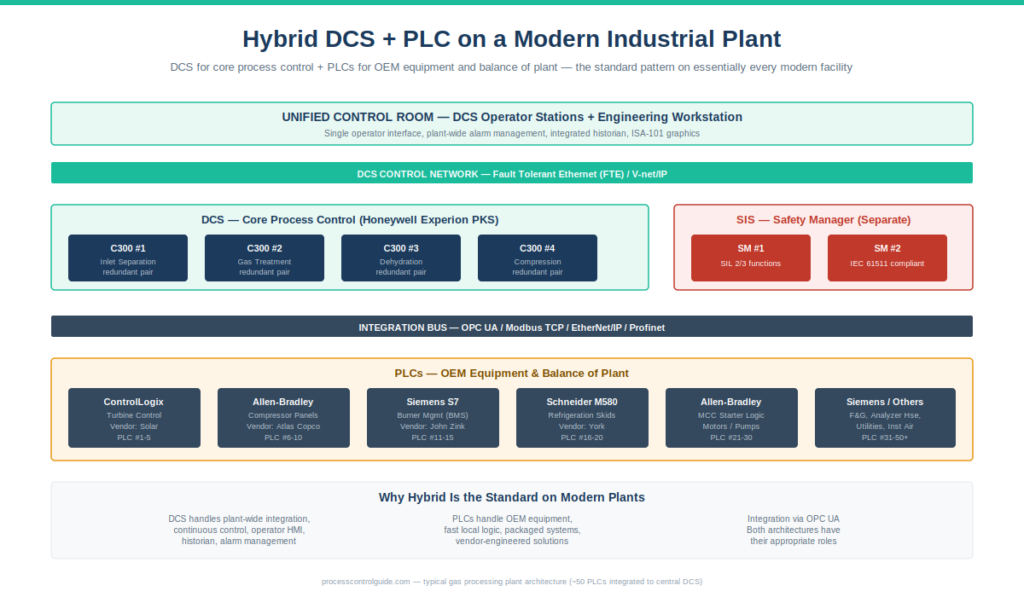
Typical hybrid architecture on a gas processing plant:
- Honeywell Experion PKS as the BPCS — controls the separation trains, gas treatment, compression, dehydration, sweetening
- Honeywell Safety Manager as the SIS — separate certified safety controllers
- Rockwell ControlLogix or Allen-Bradley PLCs on packaged equipment — turbine controls, compressor control panels, refrigeration skids, instrument air systems
- Siemens or Schneider PLCs on OEM equipment — fired heater burner management systems (BMS), analyzer houses, fire and gas systems
- PLC-based MCC starter logic for motor control centers
- All integrated to the DCS via OPC UA, Modbus TCP, or Ethernet/IP
The DCS provides the operator interface, plant-wide alarm management, historian, and integration to MES. The PLCs handle local high-speed logic and OEM-specific control. Both have appropriate roles.
Why hybrid is the right answer for most plants.
OEM equipment vendors (compressor packagers, refrigeration vendors, fired heater builders) typically supply their equipment with PLC-based control packages that they’ve engineered and tested. Replacing those PLCs with DCS controllers would require re-engineering the OEM packages, voiding vendor warranties, and adding cost without operational benefit.
The DCS handles what it does best — plant-wide integration, continuous process control, safety system coordination. The PLCs handle what they do best — fast local logic on specific equipment. This is why most DCS vs PLC discussions on real plants quickly become DCS plus PLC discussions. Modern protocols like OPC UA and Ethernet/IP make the integration straightforward.
On the oil and gas mega-project in Asia where I currently work, there are over 50 PLCs from multiple vendors integrated to the central Honeywell Experion PKS BPCS. Each has its appropriate role. The DCS vs PLC question wasn’t either/or — it was both, in their right places.
Honest Cost Comparison
The cost difference between DCS and PLC architectures is real but more nuanced than the typical “DCS is more expensive” answer.
Hardware and software CAPEX:
For an equivalent control function — say, 2,000 I/O points with redundant controllers, operator stations, and engineering workstation — DCS typically costs 1.5x to 2.5x more than PLC + SCADA at the hardware/software level. The integrated platform commands a premium.
Engineering CAPEX:
This is where the comparison gets interesting. DCS engineering is typically more efficient per I/O point because the platform integration is already done — engineers configure rather than integrate. PLC + SCADA engineering involves integration work that DCS engineers don’t do. The engineering cost per I/O can favor DCS on large projects.
For a 5,000+ I/O point project, total engineering cost is often comparable between DCS and PLC + SCADA approaches when honestly accounted for. The DCS’s higher software CAPEX is partially offset by lower engineering effort.
Lifecycle OPEX:
This is the largest cost dimension and typically favors DCS for process applications:
- DCS vendors support platforms for 25-30 years with planned migration paths
- PLC + SCADA combinations often require multiple separate vendor relationships, each with their own lifecycle
- Operator training is consolidated on one platform with DCS
- Spare parts logistics are simpler with one integrated system
- Cybersecurity is more coherent with one integrated platform
On a 30-year asset, lifecycle costs typically exceed initial CAPEX by 5-10x. Optimizing for CAPEX while ignoring OPEX is a common architecture selection mistake.
Cost summary.
Initial CAPEX favors PLC + SCADA. Engineering CAPEX is comparable on large projects. Lifecycle OPEX favors DCS for process applications. The total cost of ownership comparison depends heavily on plant size, complexity, and lifecycle expectation.
For broader project engineering context, ISA standards provide guidance on control system selection that includes lifecycle cost considerations.
Engineering and Lifecycle Considerations
Beyond cost, several engineering factors shape the DCS vs PLC selection:
Engineering team capability. A team experienced in DCS engineering will deliver a DCS project efficiently. A team experienced in PLC engineering will deliver a PLC project efficiently. Forcing a team onto an unfamiliar architecture creates schedule and quality risk. Match the architecture to the team where possible, or budget for the learning curve.
Vendor support model. DCS vendors provide deep, long-term technical support including site engineers, training centers, and migration planning. PLC vendors provide hardware and basic technical support but expect system integrators to handle complex applications. The vendor relationship is very different.
Cybersecurity. Both DCS and PLC environments face increasing cybersecurity threats. DCS platforms typically have more mature cybersecurity features (network segmentation, application whitelisting, integrated cybersecurity management) because the vendor controls the entire stack. PLC + SCADA cybersecurity depends on integration discipline across multiple vendor products.
Regulatory compliance. Industries with regulatory requirements (FDA in pharma, OSHA PSM in oil and gas, NRC in nuclear) often expect documented control system design, change management, and validation. DCS platforms typically have built-in features supporting these requirements. PLC-based systems can comply, but the documentation and change control burden is higher.
Future expansion. Plants typically expand over their lifecycle. DCS platforms are designed to scale through expansion modules with consistent engineering practices. PLC-based systems can scale, but each expansion may involve new integration work.
Migration Paths
Many projects are not greenfield — they involve migration from an existing system to a new architecture. Both PLC → DCS and DCS → PLC migrations happen, though PLC → DCS is more common in process industries.
PLC → DCS migration.
Common drivers: plant expansion has outgrown the original PLC architecture, operations are dissatisfied with fragmented HMI/historian/alarm management, regulatory requirements have changed, or the original PLC platform is reaching end of vendor support.
The migration typically involves:
- Selecting the new DCS platform
- Re-engineering control logic from PLC ladder/structured text to DCS function blocks
- Re-designing HMI screens to DCS conventions (often with ISA-101 application)
- Migrating historical data from old historian to new
- Re-validating cause and effect matrices for the safety system
- Phased cutover during turnarounds
Timelines are typically 18-36 months for medium-large facilities. The conversion is substantial engineering work because the underlying philosophy of the system changes, not just the hardware.
DCS → PLC migration.
Much less common but does happen, typically when:
- Plant size has decreased and full DCS is no longer cost-justified
- A facility is being repurposed for different (typically smaller-scale) operations
- A subsidiary or asset is being divested and the new owner standardizes on PLC platforms
The migration is generally simpler than PLC → DCS because PLC + SCADA platforms are more flexible in accepting various engineering approaches.
For broader DCS migration context, see our Honeywell Experion PKS architecture guide and Yokogawa CENTUM VP architecture guide, which discuss platform-specific migration paths.
Common Architecture Selection Mistakes I’ve Seen
After working on EPC projects across oil and gas, I’ve seen these DCS vs PLC selection mistakes recur:
Selecting PLC + SCADA for a continuous process to optimize initial CAPEX. The lifecycle costs catch up quickly when operations is unhappy with the HMI, the historian can’t keep up, and the alarm system fragments. Sometimes the system gets replaced before the plant ever produces — this is the scenario I described at the opening of this article.
Selecting DCS for a simple skid that doesn’t need it. A 200-I/O compressor skid doesn’t need a full DCS package. PLC + local HMI is the right answer, with integration to the plant DCS. Forcing DCS onto small applications wastes money and engineering effort.
Underestimating the engineering effort for hybrid integration. When a facility has DCS for core process and 30+ PLCs for OEM equipment, the integration work (communication mapping, alarm forwarding, data exchange, time synchronization) is substantial. Budget for it.
Choosing based on vendor sales pressure rather than process fit. Vendors will sell whatever they make. A Rockwell sales engineer will recommend PlantPAx for an application that’s actually better served by Experion PKS. A Honeywell sales engineer will recommend Experion for an application that’s actually a PLC skid. Independent architecture review prevents this.
Forgetting the operations team. Operations has to live with the system for 25-30 years. Their preferences, training, and existing experience matter. A facility standardized on Yokogawa CENTUM shouldn’t switch to DeltaV without strong reason; a facility with deep Rockwell expertise shouldn’t switch to Siemens without strong reason.
Treating safety systems as an afterthought. The SIS must integrate with whichever architecture is chosen. DCS platforms have native SIS integration; PLC platforms require careful design. For deeper SIS context, see our Safety Instrumented System guide.
Underestimating cybersecurity. Both DCS and PLC environments need cybersecurity attention, but the approach differs. DCS vendors typically provide integrated cybersecurity management; PLC environments require it to be designed separately.
Ignoring lifecycle migration planning. Every control system will need migration eventually. Selecting an architecture without considering the migration path 15 years out creates problems later.
Frequently Asked Questions
What is the main difference between DCS and PLC?
The main difference between DCS vs PLC is architectural philosophy, not the controllers themselves. A DCS is an integrated vendor-supplied package combining controllers, HMI, engineering tools, historian, and alarm management designed to work together. A PLC is a single controller that requires separately-procured HMI (SCADA), historian, and engineering tools integrated by the user.
Is a PLC faster than a DCS?
Yes, PLCs typically have faster scan times (1-50ms) than DCS controllers (100-500ms). This matters for discrete and motion control applications but is generally irrelevant for continuous process control where process time constants are seconds to minutes.
Can a PLC replace a DCS?
In some applications yes, particularly with modern PAC-style products like Rockwell PlantPAx. For very large continuous processes with 10,000+ I/O, multiple control rooms, integrated safety systems, and 30-year lifecycle expectations, traditional DCS platforms still have advantages. The answer depends on application size and complexity.
What is the cost difference between DCS and PLC?
DCS typically costs 1.5-2.5x more than PLC + SCADA for equivalent control functions at the hardware/software level. However, when total engineering and lifecycle costs are honestly accounted for over 30 years, the comparison narrows significantly and often favors DCS for process applications.
Which is more reliable — DCS or PLC?
Both can be made highly reliable, but DCS platforms typically provide built-in redundancy (hot standby controllers, redundant networks, redundant power supplies) as standard. PLC redundancy is available but typically costs more and requires more engineering. For mission-critical continuous processes, DCS is the more typical choice.
Is a PLC easier to program than a DCS?
PLCs typically use IEC 61131-3 languages (ladder logic, structured text, function block diagram, sequential function chart). DCS platforms use vendor-specific function block environments that are conceptually similar but with different tools. Neither is fundamentally easier; engineers typically prefer whichever they have more experience with.
Can DCS and PLC work together?
Yes — hybrid architectures combining DCS for core process control and PLCs for OEM equipment, utilities, and balance-of-plant are the standard on modern industrial facilities. Integration is typically via OPC UA, Ethernet/IP, or Modbus TCP. On essentially every modern plant, both architectures coexist with appropriate roles.
When should I use DCS vs PLC for my project?
Use DCS for continuous processes with 2,000+ I/O, multiple operator stations, integrated safety systems, and 25-30 year lifecycle expectations. Use PLC + SCADA for discrete manufacturing, machine-level control, applications under 500 I/O, and OEM equipment skids. Use hybrid architectures (DCS + PLC) for plants combining continuous process with OEM equipment — which is most modern facilities.
Which DCS vs PLC platform should I choose?
Major DCS platforms: Honeywell Experion PKS, Yokogawa CENTUM VP, Emerson DeltaV, ABB 800xA, Siemens PCS 7. Major PLC platforms: Rockwell ControlLogix, Siemens S7-1500, Schneider Modicon M580, Mitsubishi MELSEC. Platform selection depends on installed base at your facility, industry-specific requirements, engineering preference, and lifecycle support considerations.
Conclusion
The DCS vs PLC question is one of the most consequential architectural decisions in any industrial control project. The choice shapes engineering effort during the project, operations experience during the lifecycle, and the cost structure for 25-30 years. Getting the DCS vs PLC decision right requires understanding the real architectural differences, the modern landscape of PAC platforms that blur the historical distinction, and the honest fit between architecture and application.
The most important practical truths about DCS vs PLC:
- DCS is an integrated package; PLC is a controller. The architectural difference matters more than the hardware difference
- The modern blur (PlantPAx, ControlLogix on process) means the binary choice is now a spectrum
- Hybrid architectures combining DCS and PLC are the standard on modern industrial facilities, not the exception
- CAPEX optimization without lifecycle consideration is the most common selection mistake
- Architecture should match the process, the operations team, and the lifecycle expectations — not vendor preferences or initial cost optimization
On every major project I’ve been part of, the DCS vs PLC question has been a serious architectural conversation, not a defaulted choice. Refineries, gas plants, and petrochemical complexes typically land on Honeywell, Yokogawa, or Emerson DCS platforms with extensive PLC integration for OEM equipment. Smaller process facilities sometimes land on PlantPAx or hybrid architectures. Discrete manufacturing and OEM skids land on PLCs. Each choice reflects the specific application, operations context, and lifecycle expectation.
If you’re approaching a control system architecture decision, resist the temptation to default to whatever your engineering team is most comfortable with. Evaluate the actual application requirements honestly. Consider lifecycle costs, not just CAPEX. Engage operations in the decision. Plan for migration 15-20 years out. And recognize that the modern automation landscape often calls for hybrid architectures combining the strengths of both DCS and PLC.
For broader DCS context, see our What Is a DCS cornerstone guide. For PLC-specific resources covering programming, hardware selection, and applications, see our sister site controlsystemguide.com. For vendor-specific DCS architecture deep-dives, see our Honeywell Experion PKS architecture guide, Yokogawa CENTUM VP architecture guide, and Emerson DeltaV architecture guide.
For the related comparison of DCS vs SCADA — the geographic scope distinction and the modern hybrid pattern where both architectures coexist — see our DCS vs SCADA Explained guide.
For the three-way comparison that combines this DCS vs PLC analysis with SCADA — including the decision framework for partitioning scope across all three architectures and the hybrid pattern on modern plants — see our DCS vs SCADA vs PLC capstone guide.
About the Author
Daniel Reed is an Instrument and Controls Engineer with 14+ years of oil and gas EPC experience across onshore and offshore projects in Asia and Africa. He currently works as a client-side I&C completion engineer on a large oil and gas mega-project in Asia, where he has been involved with Honeywell Experion PKS and Safety Manager since 2018.
His earlier work covered Yokogawa CENTUM and Triconex SIS on an offshore brownfield in Africa (2015-2018), and Yokogawa CENTUM and ProSafe-RS on a gas-to-liquids facility in Africa. His focus is engineering deliverable review, control and safety system commissioning, HAZOP/SIL/SIF participation, FAT/SAT execution, loop tuning across multiple DCS platforms, and vendor coordination across Honeywell, Yokogawa, Triconex, Allen-Bradley, and Siemens platforms.