
I’ve sat through enough alarm rationalization workshops to know that the first day is always the hardest. The room is full of operators who stopped trusting the alarm system years ago, a process engineer who wants to keep every alarm “just in case”, and a facilitator trying to hold the line on the philosophy document. By the end of the week, if it’s done well, the plant has an alarm system an operator can actually use in an upset.
Most of what’s written about alarm rationalization online stops at the definition, or hands you a vendor whitepaper and a sales call. What’s missing is the part engineers actually ask for: the step-by-step of how a rationalization workshop runs, what gets recorded for each alarm, and the hard numbers ISA-18.2 expects you to hit afterwards.
This guide covers all of that. If you’ve read our ISA-18.2 Alarm Management guide, this article is the hands-on companion focused on the rationalization step itself.
TL;DR — Quick Answer: What Is Alarm Rationalization?
Alarm rationalization is the structured process of reviewing every existing and proposed alarm against the plant’s alarm philosophy, keeping only the alarms that are genuinely necessary, and documenting the cause, consequence, operator response, setpoint, and priority for each one. It is the step in the ISA-18.2 (and IEC 62682) alarm management lifecycle that turns an overloaded alarm system into a usable one.
Rationalization is done in a facilitated workshop with operators, a process engineer, and a controls engineer. Each alarm must justify its existence against three tests: there is a real consequence if it is ignored, the operator has a defined action to take, and there is enough time to take it. Alarms that fail are removed, downgraded, or re-engineered. The results are recorded in the master alarm database (MADB), which becomes the single source of truth for the alarm system.
Key points on alarm rationalization:
- It is Step C of the ISA-18.2 alarm management lifecycle
- The alarm philosophy document must exist before it starts
- Every alarm needs a consequence, an operator action, and time to respond
- Nuisance alarms (chattering, fleeting, stale, standing) are fixed or removed
- Each alarm’s details are recorded in the master alarm database
- The target is roughly 1 alarm per 10 minutes per operator in steady state
- It must be sustained afterwards through management of change
What You Will Learn
This guide covers alarm rationalization at the depth a working controls or process engineer actually needs:
- What alarm rationalization is and where it sits in ISA-18.2
- The nuisance alarm types and how each one is fixed
- The prerequisites — the alarm philosophy and a benchmark
- The step-by-step rationalization workshop procedure
- What gets documented for every alarm in the MADB
- The ISA-18.2 performance benchmarks you are aiming for
What Is Alarm Rationalization?
Alarm rationalization is the review of every alarm in a plant against a documented set of rules — the alarm philosophy — to decide which alarms should exist, what priority each should carry, and what the operator should do when it activates. It is one stage in the broader alarm management lifecycle defined by ANSI/ISA-18.2 and its international twin, IEC 62682.
The problem it solves is alarm overload. Over the life of a plant, alarms get added freely — every modification, every incident, every “let’s put an alarm on that” — and almost none get removed. The result is an alarm system that floods the operator during exactly the upsets it was meant to help with. Rationalization is the disciplined cull that makes the system trustworthy again.
The core principle is simple: an alarm is a call to action. If there is nothing the operator can or should do in response, it is not an alarm — it is noise. Everything in rationalization flows from that one idea. For the systems that generate and present these alarms, see our What Is a DCS guide.
Nuisance Alarms and How Each One Is Fixed
Before rationalization can set targets, it helps to know the enemy. Nuisance alarms are the alarms that activate without providing useful information, and ISA-18.2 recognises several distinct types. Each has a specific fix.
Chattering alarms repeatedly transition on and off in a short period, usually because a measurement is sitting right at the setpoint with noise on it. The fix is deadband (hysteresis) and an on-delay, so the alarm only activates when the signal is genuinely past the limit for a set time.
Fleeting alarms activate and clear before the operator can respond, adding count without adding value. An on-delay timer suppresses the brief excursions while letting real ones through.
Stale alarms stay active for a long period — hours or days — usually because the condition is known and accepted but never resolved. They clutter the display and hide new alarms. The fix is to resolve the underlying condition or to shelve the alarm with a time limit.
Standing alarms are the population of alarms active at any given moment during normal operation. A healthy system has very few; a poor one has dozens, so the operator starts each shift already saturated.
A small number of alarms almost always cause most of the load. On the systems I’ve worked, the top ten “bad actors” routinely account for the majority of the alarm count, which makes them the fastest early win before the full workshop even starts. Alarm presentation on the operator display is governed by ISA-101 HMI design.
The Prerequisites — Philosophy and Benchmark
Rationalization cannot start cold. Two things have to be in place first, and skipping either one is the most common reason a workshop produces inconsistent results.
The alarm philosophy document. This is the rulebook. It defines what qualifies as an alarm, how priorities are assigned, the standard setpoint and deadband conventions, the classes of alarm (for example safety-related versus operational), and the performance targets the plant is aiming for. Without it, every alarm becomes a debate, and two facilitators would reach two different answers. The philosophy makes rationalization repeatable.
A benchmark. Before you change anything, measure the current alarm system — average alarm rate, peak rates during upsets, the standing alarm count, and the bad actors. The benchmark tells you how bad the problem is, gives you a baseline to prove improvement against, and points to the quick wins. For the safety-related alarms that intersect with the protective layers, see our Safety Instrumented System guide.
The Step-by-Step Rationalization Workshop
This is the part most guides skip. A rationalization workshop is a facilitated, methodical review, and it runs in a defined sequence. Here is how the workshops I’ve been part of are structured.
- Set the scope. Take a manageable slice — the alarms under one operator’s span of control, or one unit or process area. Trying to do a whole plant in one sitting burns out the team and the quality drops.
- Assemble the team. One or two experienced operators, a process engineer, a controls or instrument engineer, and a facilitator who owns the method. The operators are the most important people in the room; they know which alarms actually help.
- Take each alarm in turn. For every existing and proposed alarm, work through the three tests: Is there a real consequence if it is ignored? Does the operator have a specific action to take? Is there enough time to take that action before the consequence occurs?
- Decide the alarm’s fate. If it passes all three tests, keep it and document it. If there is no consequence or no action, remove it. If the response time is too short for the operator to act, it is a candidate for an automated function or a safety instrumented function, not an alarm.
- Set the priority. For each kept alarm, assign priority from the consequence severity and the time available to respond. Higher consequence and less time means higher priority. The philosophy defines the exact mapping.
- Specify the design. Record the setpoint, the deadband, any on-delay, the measurement, and the engineering limits. This is where chattering and fleeting alarms are engineered out rather than just noted.
- Document in the MADB. Capture the cause, the consequence, the corrective operator action, and the priority in the master alarm database. If it is not in the MADB, it does not officially exist.
- Calibrate the team first. Before the full run, rationalize a handful of representative alarms together so the whole team applies the priority rules consistently. This calibration pass is what keeps the first day’s decisions consistent with the last day’s.
A realistic pace is 20 to 40 alarms a day with a fresh team, slower at the start and faster once the calibration settles in. Rushing the rate is how inconsistent priorities creep in.
What Gets Documented for Every Alarm
The output of rationalization is the master alarm database, and its value depends entirely on the discipline of what goes into it. For each alarm that survives, the MADB records a defined set of fields.
| Field | What it captures |
|---|---|
| Tag and description | The point and a plain-language name |
| Cause | What process condition triggers the alarm |
| Consequence | What happens if the operator does not act |
| Operator action | The specific, defined response |
| Time to respond | How long the operator has before the consequence |
| Setpoint and deadband | The trip limit and the hysteresis |
| On-delay | Any time delay to suppress fleeting activations |
| Priority | Low, medium, high, or critical |
| Alarm class | Safety-related, operational, or other |
The MADB is the single source of truth. When a future change proposes a new alarm or a setpoint change, it is checked and recorded here, which is what keeps the system rationalized over time rather than drifting straight back to overload.
Alarm Prioritization — How Priority Is Assigned
Priority is not a guess, and it is not “how worried does this make me”. ISA-18.2 ties it to two measurable things: the severity of the consequence if the alarm is ignored, and the time the operator has to respond. The philosophy document turns those into a simple matrix.
| Consequence severity | Long time to respond | Short time to respond |
|---|---|---|
| Minor | Low | Medium |
| Major | Medium | High |
| Severe | High | Critical |
A severe consequence with very little time to act is a critical alarm; a minor consequence with plenty of time is a low-priority alarm. The point of tying priority to these two factors is that it is objective and repeatable — two engineers using the same matrix reach the same priority, which is exactly what rationalization is trying to achieve.
The philosophy also sets the target distribution of priorities. A common target is roughly 80 percent low, 15 percent medium, and 5 percent high priority. If a plant has 40 percent high-priority alarms, the priorities have lost their meaning, because when everything is urgent, nothing is.
ISA-18.2 Performance Benchmarks You Are Aiming For
This is the section the vendor articles leave out, and it is the one engineers most want. Rationalization is judged against measurable targets, drawn from ISA-18.2 and the EEMUA 191 guidance it builds on. These are the numbers to aim for, per operator console.
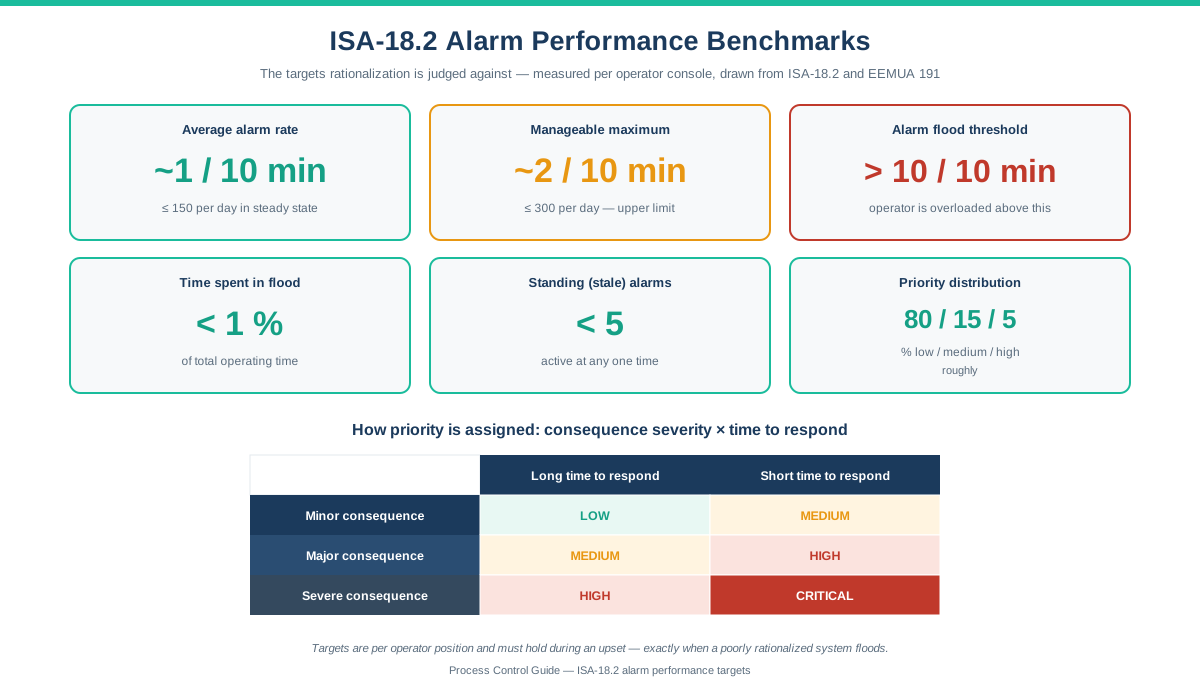
| Metric | Target |
|---|---|
| Average alarm rate (steady state) | ~1 alarm per 10 minutes (≤150 per day) |
| Manageable maximum | ~2 alarms per 10 minutes (≤300 per day) |
| Alarm flood threshold | more than 10 alarms in 10 minutes |
| Time spent in alarm flood | less than 1 percent |
| Standing (stale) alarms | fewer than 5 at any time |
| Priority distribution | roughly 80% low / 15% medium / 5% high |
| Contribution of top 10 bad actors | should be small after rationalization |
These targets are per operator position, not per plant. An average of one alarm every ten minutes sounds gentle until you remember it has to hold during an upset, which is precisely when a poorly rationalized system buries the operator under hundreds of alarms in minutes. The whole point of rationalization is to keep the system usable in that moment. These benchmarks sit alongside the broader standard covered in our ISA-18.2 Alarm Management guide.
How the Major DCS Platforms Support Rationalization
Rationalization is a methodology, not a feature, but every major DCS provides the alarm configuration and analysis tools that make it work. The method is identical across platforms; only the terminology and the tooling differ.
Honeywell Experion PKS provides alarm configuration with deadband, on-delay, and priority settings, plus alarm performance reporting to benchmark against the targets. For the platform, see our Honeywell Experion PKS guide.
Yokogawa CENTUM VP offers consolidated alarm management with shelving and suppression functions, and the analysis tools to find bad actors. For the platform, see our Yokogawa CENTUM VP guide.
Emerson DeltaV includes alarm configuration and analytics, with DeltaV Analyze reporting against ISA-18.2 metrics. For the platform, see our Emerson DeltaV guide.
Whichever platform is in use, the MADB usually lives outside the DCS in a dedicated alarm management tool, so the rationalized design is preserved independently of the control system and survives a migration.
Sustaining It — Rationalization Is Not a One-Time Event
The mistake that undoes a good workshop is treating rationalization as a project with an end date. Within a couple of years, an un-maintained alarm system drifts straight back to overload, because the same pressures that caused the original mess — add an alarm after every incident, never remove one — are still there.
The fix is management of change. Every proposed new alarm or setpoint change goes through the same three tests and gets recorded in the MADB before it is implemented. The plant also monitors the live performance against the benchmarks, so a rising alarm rate or a growing standing-alarm count is caught early. Rationalization that is sustained this way keeps paying back; rationalization that is filed and forgotten is wasted within a turnaround or two.
Common Alarm Rationalization Mistakes
Based on project experience, here are the recurring mistakes worth watching for:
Starting without an alarm philosophy. Rationalizing with no rulebook means every alarm is a fresh argument and the priorities end up inconsistent. The philosophy comes first, always.
Keeping alarms “just in case”. An alarm with no defined operator action is noise, however reassuring it feels to keep it. If there is nothing to do, it should not be an alarm.
Treating a short response time as a high-priority alarm. If the operator cannot realistically act in time, the answer is an automated trip or a safety instrumented function, not a louder alarm.
Skipping the calibration pass. Without rationalizing a few alarms together first, the team applies priorities inconsistently, and the first day’s work does not match the last.
Ignoring the bad actors before the workshop. The top ten chattering and fleeting alarms often cause most of the load and can be fixed quickly, which makes the whole exercise easier.
No management of change afterwards. Without MOC, the rationalized system drifts back to overload within a turnaround or two, and the whole effort is wasted.
Letting one person dominate. If the process engineer overrides the operators on every call, the result is an alarm system that looks good on paper and still floods in practice. The operators know which alarms help.
Frequently Asked Questions
What is alarm rationalization?
Alarm rationalization is the structured review of every existing and proposed alarm against the plant’s alarm philosophy, keeping only the alarms that are genuinely necessary and documenting the cause, consequence, operator action, setpoint, and priority for each. It is the step in the ISA-18.2 alarm management lifecycle that makes an overloaded alarm system usable again.
What are the three tests an alarm must pass?
To survive rationalization, an alarm must pass three tests: there is a real consequence if the operator ignores it, the operator has a specific defined action to take, and there is enough time to take that action before the consequence occurs. An alarm that fails any of the three is removed, downgraded, or re-engineered.
What is the master alarm database (MADB)?
The master alarm database is the single source of truth for the alarm system. It records, for every rationalized alarm, the tag, cause, consequence, operator action, time to respond, setpoint, deadband, priority, and alarm class. New alarms and changes go through the MADB, which is what keeps the system rationalized over time.
What is a nuisance alarm?
A nuisance alarm activates without giving the operator useful, actionable information. ISA-18.2 recognises several types: chattering (rapidly on and off), fleeting (clears before the operator can act), stale (active for a long period), and a high population of standing alarms. Each type has a specific fix — deadband, on-delay, resolution, or shelving.
What is the target alarm rate under ISA-18.2?
The ISA-18.2 target is roughly one alarm per ten minutes per operator in steady state — about 150 alarms per day — with about two per ten minutes considered the manageable maximum. An alarm flood is more than ten alarms in ten minutes, and the system should spend less than one percent of the time in flood.
How is alarm priority assigned?
Priority is assigned from the consequence severity if the alarm is ignored and the time the operator has to respond. Higher consequence and shorter time means higher priority. The alarm philosophy defines the exact matrix, which makes priority objective and repeatable. A common target distribution is about 80 percent low, 15 percent medium, and 5 percent high.
Who should be in a rationalization workshop?
A rationalization workshop needs one or two experienced operators, a process engineer, a controls or instrument engineer, and a facilitator who owns the method. The operators are the most important people in the room because they know which alarms genuinely help during an upset and which ones are ignored.
What standards cover alarm rationalization?
Alarm rationalization is defined in ANSI/ISA-18.2, with the identical international standard IEC 62682. Both build on the earlier EEMUA 191 guidance. These standards define the alarm management lifecycle, the performance benchmarks, and the role of rationalization within them. For the full standard, see our ISA-18.2 Alarm Management guide.
Conclusion
Alarm rationalization is the step that turns an alarm system from a liability into a tool. It is not glamorous work — it is a week in a room taking every alarm in turn and asking whether it earns its place — but it is the single most effective thing a plant can do to make its control system usable in an upset.
The most important practical truths about alarm rationalization:
- An alarm is a call to action; if there is nothing to do, it is not an alarm
- The alarm philosophy must exist before rationalization starts
- Every alarm must pass the consequence, action, and time tests
- Priority comes from consequence severity and time to respond, not gut feel
- The target is about one alarm per ten minutes per operator in steady state
- The master alarm database is the single source of truth
- Management of change is what keeps the system rationalized over time
If you take one thing away, let it be that the operators in the room are the real authority. The process engineer knows what the alarm was for; the operator knows whether it actually helps at three in the morning during a trip. A rationalization that listens to them produces an alarm system people trust — and a trusted alarm system is the whole point.
For the full standard this builds on, see our ISA-18.2 Alarm Management guide. For related topics, see our ISA-101 HMI Design guide, Safety Instrumented System guide, and What Is a DCS guide.
About the Author
Daniel Reed is an Instrument and Controls Engineer with 14+ years of oil and gas EPC experience across onshore and offshore projects in Asia and Africa. He currently works as a client-side I&C completion engineer on a large oil and gas mega-project in Asia, working with Honeywell Experion PKS and Safety Manager since 2018.
His earlier work covered Yokogawa CENTUM and Triconex SIS on an offshore brownfield in Africa, and Yokogawa CENTUM and ProSafe-RS on a gas-to-liquids facility in Africa. His focus is engineering deliverable review, control and safety system commissioning, HAZOP/SIL/SIF participation, FAT/SAT execution, and vendor coordination across Honeywell, Yokogawa, Triconex, Allen-Bradley, and Siemens platforms.