
On one of the offshore brownfield projects I worked on in Africa, I had the unusual experience of seeing all three industrial control architectures running side by side on the same operation. The main process platform ran a Yokogawa CENTUM DCS with Triconex SIS — classic continuous control with thousands of I/O wired back to the central control room.
The OEM equipment skids (the gas compressors, the water injection package, the chemical injection systems) all ran on Allen-Bradley and Siemens PLCs supplied by their respective vendors. And the onshore control center 80 kilometers away monitored the entire field via SCADA, with separate communication links to the platform, the subsea wellheads, and three remote injection sites.
Three control architectures, one operation, each doing what it does best. The DCS handled continuous process control on the platform. The PLCs handled fast local logic on packaged equipment. The SCADA gave the onshore team supervisory visibility across the geographically distributed assets. No one architecture could have handled all three jobs well. Trying to force a single architecture across the entire scope would have created problems that ended up much more expensive than the integration work between them.
That experience shaped how I think about the DCS vs SCADA vs PLC question. It isn’t really a competition between three alternatives for the same job. These are three architectures designed for three different problems, and most modern industrial operations need all three working together in their appropriate roles. The selection decision isn’t “which one do I choose?” — it’s “where does each one belong, and how do they integrate?”
This guide is the capstone of our three-article DCS vs Other Systems cluster. If you want the deep two-way comparisons, see our DCS vs PLC guide and DCS vs SCADA guide. This article focuses on the DCS vs SCADA vs PLC three-way decision framework, the hybrid reality of modern plants, and how the architectures integrate with each other.
TL;DR — Quick Answer: DCS vs SCADA vs PLC
The DCS vs SCADA vs PLC question is best answered as a three-way fit decision, not a winner-takes-all comparison:
- DCS (Distributed Control System) — integrated platform for continuous process control within a single facility. Used for refineries, gas plants, petrochemical complexes, power stations, large pharmaceutical batch operations. Honeywell Experion PKS, Yokogawa CENTUM VP, Emerson DeltaV, ABB 800xA, Siemens PCS 7.
- PLC (Programmable Logic Controller) — single controller for discrete machine control and OEM equipment. Used for packaged equipment skids, discrete manufacturing, small process applications, motor control. Allen-Bradley ControlLogix, Siemens S7-1500, Schneider Modicon, Mitsubishi MELSEC.
- SCADA (Supervisory Control and Data Acquisition) — software architecture for wide-area supervisory monitoring of geographically distributed assets. Used for pipelines, water networks, power grids, multi-site oilfield operations. Wonderware (AVEVA), Inductive Automation Ignition, GE iFIX, Schneider Citect, Siemens WinCC.
The standard pattern on modern industrial facilities is hybrid: DCS handles continuous process control inside each facility, PLCs handle OEM equipment and discrete operations, SCADA spans multiple sites for supervisory monitoring. The DCS vs SCADA vs PLC selection isn’t either/or — it’s where each one belongs in the overall architecture.
Quick decision rules:
- Inside a single continuous process facility → DCS for core control
- OEM equipment, packaged skids, fast discrete logic → PLC
- Multiple geographically distributed sites monitored from a central operations center → SCADA
- A modern operation with all three conditions → all three architectures coexisting
What You Will Learn
This capstone guide covers DCS vs SCADA vs PLC at the architectural decision level:
- The three-way distinction at a glance (with links to deeper two-way comparisons)
- Why most modern plants use all three architectures together
- A practical decision framework for selecting each architecture
- The 15 key differences across all three systems
- When to choose each architecture (with cross-links to the deep-dive articles)
- The standard hybrid pattern on real industrial plants
- How DCS, PLC, and SCADA integrate with each other
- Honest cost comparison across all three categories
- Common three-way selection mistakes I’ve seen
- Vendor landscape across DCS, PLC, and SCADA
The Three Architectures at a Glance
A brief DCS vs SCADA vs PLC summary of each architecture before we get to the decision framework. For deeper treatment of any two-way comparison, follow the links to the dedicated sibling articles.
DCS — Integrated platform for continuous process control.
A DCS is a vendor-supplied integrated package combining controllers, operator interface, engineering tools, historian, alarm management, and often safety systems. It’s designed for a single facility where everything is wired together inside the plant. The architectural identity of a DCS is “the integrated system that runs the plant.”
For the complete treatment of what a DCS is, see our What Is a DCS cornerstone guide. For specific vendor architectures, see our Honeywell Experion PKS guide, Yokogawa CENTUM VP guide, and Emerson DeltaV guide.
PLC — Single controller for discrete and machine-level control.
A PLC is a ruggedized industrial controller designed for fast deterministic logic execution. PLCs excel at discrete operations (machine sequencing, motion control, motor starting) and at high-speed local logic on packaged equipment. The architectural identity of a PLC is “the controller that runs the logic.” HMI, historian, and engineering tools are procured separately and integrated by the user or system integrator.
For PLC-focused content covering programming, hardware, and applications, see our sister site controlsystemguide.com. For the two-way comparison with DCS, see our DCS vs PLC guide.
SCADA — Software architecture for wide-area supervisory monitoring.
A SCADA system is a software architecture designed for supervisory monitoring of geographically distributed assets. The SCADA master station collects data from remote sites (where RTUs or PLCs handle local control) over wide-area communications. SCADA excels at wide-area visibility — pipeline networks, water systems, power grids, multi-site oilfield operations. The architectural identity of SCADA is “the supervisory system that watches the network.”
For the two-way comparison with DCS, see our DCS vs SCADA guide, which covers the geographic scope distinction in depth.
Why Most Modern Plants Use All Three
The most important truth about DCS vs SCADA vs PLC is that the question is rarely either/or on real industrial operations. Most modern plants combine all three architectures in their appropriate roles.
Typical DCS vs SCADA vs PLC distribution inside a single process facility:
- DCS runs the core continuous process — separation, treatment, compression, reaction
- PLCs run OEM equipment — turbines, compressors, fired heaters, refrigeration skids, motor control centers
- All wired together inside the plant fence
- One control room with the DCS HMI as the primary operator interface
Typical DCS vs SCADA vs PLC distribution across multiple facilities:
- Each facility has its own DCS for in-plant control
- SCADA at the central operations center provides supervisory monitoring of all facilities
- Wide-area communications link the central SCADA to each site
- The local DCS operator sees the live process; the central SCADA operator sees the network
On the offshore brownfield project I mentioned at the opening of this article, the three architectures had clear roles:
- CENTUM DCS on the main process platform handling continuous control of separation, gas treatment, water injection, and oil export
- Allen-Bradley and Siemens PLCs on the compressor packages, chemical injection systems, water treatment skids, and emergency shutdown systems supplied by various OEMs
- SCADA at the onshore control center monitoring the main platform, three remote wellhead facilities, two subsea umbilical control systems, and a small injection platform 30 kilometers away
No one architecture could have handled all three jobs. The DCS wasn’t designed for wide-area pipeline monitoring. The SCADA wasn’t designed for sub-second deterministic control loops. The PLCs weren’t designed to provide a unified plant-wide operator interface. Each architecture did what it was designed for, and the integration between them made the overall operation work.
This pattern repeats across the oil and gas industry, the water utility industry, the electrical utility industry, and modern manufacturing. The DCS vs SCADA vs PLC reality on these operations isn’t binary. The DCS vs SCADA vs PLC question on these operations isn’t a selection competition — it’s a partition decision about which architecture handles which scope.
The Practical Selection Decision Framework
Use this DCS vs SCADA vs PLC decision framework to determine which architecture belongs where in your overall operation.
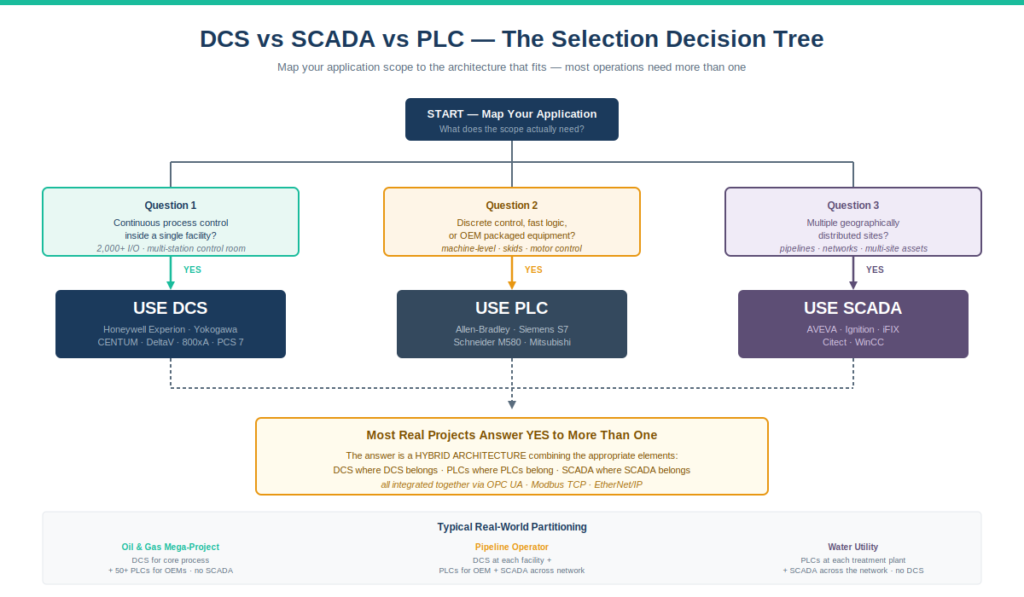
Question 1: Is the application continuous process control inside a single facility?
If yes → DCS is the primary choice. The integrated platform handles continuous control, integrated safety, plant-wide alarm management, and historian in one vendor-supplied package. Justified for facilities with 2,000+ I/O, multiple operator stations, and 25-30 year lifecycle expectations.
Question 2: Is the application discrete control, fast logic, or OEM packaged equipment?
If yes → PLC is the right choice. Whether the equipment is integrated to a larger DCS or standalone with its own HMI, PLC hardware is the appropriate controller for discrete operations and machine-level control. Cost-effective for applications where DCS integration would be over-engineering.
Question 3: Are there multiple geographically distributed sites that need supervisory monitoring from a central location?
If yes → SCADA is the supervisory layer. The master station collects data from remote sites and provides unified visibility across the network. Required for any operation spanning facilities, pipelines, distribution networks, or multi-site assets.
Question 4: Do you have more than one “yes” answer above?
This is the most common case on real operations. The answer is a hybrid architecture combining the appropriate elements: DCS where DCS belongs, PLCs where PLCs belong, SCADA where SCADA belongs, all integrated together via standard protocols.
The decision isn’t which one to choose — it’s how to partition the scope across the three architectures.
The 15 Key Differences Across All Three
A side-by-side DCS vs SCADA vs PLC comparison of the differences that matter in practice:
| # | Aspect | DCS | PLC | SCADA |
|---|---|---|---|---|
| 1 | Architecture | Integrated platform | Single controller | Software architecture |
| 2 | Scope | Single facility | Single machine/skid | Multiple distributed sites |
| 3 | Primary purpose | Continuous process control | Discrete machine control | Supervisory monitoring |
| 4 | Geographic reach | Inside the fence | Local equipment | Across the network |
| 5 | Scan/update time | 100-500ms | 1-50ms | Seconds to minutes |
| 6 | Communication | Redundant LAN | Industrial Ethernet | WAN (cellular/MPLS/satellite) |
| 7 | Typical I/O scale | 2,000-50,000+ | Hundreds to low thousands | Hundreds-thousands across sites |
| 8 | Redundancy | Built-in standard | Available at extra cost | Master station redundancy |
| 9 | HMI | Integrated with platform | Separately procured | Master station software |
| 10 | Safety integration | Native vendor SIS | Separate SIS via comms | Not safety-rated |
| 11 | Lifecycle support | 25-30 years | 15-20 years | 10-15 years |
| 12 | Vendor model | Single vendor stack | Multi-vendor flexibility | Multi-vendor expected |
| 13 | Engineering effort | Configuration of platform | Integration of components | Communications + HMI |
| 14 | Typical CAPEX | $500K-$10M+ per plant | $5K-$50K per panel | $100K-$2M per network |
| 15 | Operator interaction | Continuous live monitoring | Local equipment HMI | Exception-based supervisory |
The pattern in this table is consistent: DCS optimizes for integrated plant-wide control, PLCs optimize for fast local control, SCADA optimizes for wide-area supervision. Each has clear strengths in its design domain.
When to Choose DCS
DCS is the right primary architecture for continuous process facilities with:
- Single-location operations within a defined plant boundary
- Continuous process running 24/7 between turnarounds
- 2,000+ I/O tags (typically much higher)
- Integrated safety system requirements
- Multiple operator stations in a coordinated control room
- 25-30 year lifecycle expectations
- Industries: refining, petrochemicals, gas processing, power generation, large pharma, pulp and paper
For the deep treatment of when DCS is the right choice and the architectural decision factors, see our DCS vs PLC guide. For DCS architecture fundamentals, see our What Is a DCS cornerstone guide.
When to Choose PLC
PLC is the right architecture for:
- OEM packaged equipment (compressors, refrigeration, turbines, fired heaters)
- Discrete manufacturing operations
- Small process applications under 500 I/O
- Motor control centers
- Machine-level sequencing and motion control
- Applications requiring sub-10ms response times
- Integration with larger DCS facility via OPC UA or Ethernet/IP
PLCs rarely stand alone on large operations. They typically integrate to a larger DCS or SCADA architecture handling the broader operational scope. For PLC-specific resources covering programming, hardware selection, and applications, see our sister site controlsystemguide.com.
When to Choose SCADA
SCADA is the right architecture for:
- Pipelines and pipeline networks
- Water and wastewater distribution networks
- Electrical transmission and distribution grids
- Natural gas distribution networks
- Multi-site oil and gas operations (gathering systems, remote wells)
- Tank farm and terminal operations spanning multiple sites
- Renewable energy networks (wind farms, distributed solar)
- District heating and cooling networks
SCADA is the supervisory layer above field-level control (PLCs or DCS at each site). For the deep comparison of SCADA with DCS architecture, see our DCS vs SCADA guide, which covers the geographic scope distinction in detail.
Hybrid Architectures — The Real Industrial Pattern
The hybrid pattern combining DCS, PLC, and SCADA is the standard on modern industrial operations. Here are typical examples from oil and gas, where I’ve worked extensively.
Typical oil and gas mega-project (single large facility):
- DCS — Honeywell Experion PKS as the BPCS controlling continuous process operations across 4-8 dedicated controllers, with 10,000+ I/O
- DCS-integrated SIS — Honeywell Safety Manager as the certified safety system, tightly integrated with the BPCS
- PLCs — 50+ PLCs from multiple vendors on OEM equipment (gas turbines on Solar/Mark VI, compressor packages on Allen-Bradley, fired heater BMS on Siemens, refrigeration skids on Schneider, F&G systems on dedicated controllers, motor control center starters on Allen-Bradley)
- No SCADA — the entire operation is within one plant boundary, so DCS handles all plant-wide operator interface needs
Typical pipeline operator (multi-site operation):
- DCS at each compressor station — local continuous process control
- DCS at each pump station — local continuous process control
- DCS at each terminal/tank farm — local continuous process control
- PLCs at each location — for local OEM equipment (turbines, compressors, packaged systems)
- SCADA at the central operations center — pipeline-wide supervisory monitoring across all facilities, communications via fiber/MPLS/cellular
- Local operators at each facility see live process detail via the local DCS
- Central operators see the network-wide picture via SCADA
Typical municipal water utility:
- PLCs at each water treatment plant — local control of clarification, filtration, disinfection
- PLCs at each pump station — local control of pumping operations
- PLCs at each elevated tank — level control and management
- SCADA at the central operations center — network-wide supervision of all treatment plants, pump stations, tanks, and distribution
- No DCS — water utility operations are typically PLC-based at the field level (smaller continuous processes than oil and gas) with SCADA handling supervisory roles
These patterns are the norm, not the exception. The DCS vs SCADA vs PLC question on these operations is about partitioning scope, not selecting one architecture.
Integration Between DCS, PLC, and SCADA
Modern integration between the three DCS vs SCADA vs PLC architectures relies on standard protocols and well-defined interfaces. Engineering the integration is often more complex than engineering the individual systems.
Common integration protocols:
- OPC UA — the modern standard for cross-vendor integration, increasingly adopted by all three architectures
- Modbus TCP/IP — universal industrial protocol, supported by essentially every controller and SCADA platform
- EtherNet/IP — Rockwell’s protocol, widely supported by PLC and DCS vendors
- PROFINET — Siemens’ protocol, common in European-influenced projects
- DNP3 — common in electrical utility SCADA applications
- IEC 60870-5 — common in electrical and water utility SCADA
Common integration patterns:
- PLC-to-DCS — OEM equipment PLCs typically map their alarm, status, and process data to the DCS via Modbus TCP or EtherNet/IP. The DCS treats the PLC as a remote I/O subsystem, with alarms forwarded to the plant-wide alarm management system.
- DCS-to-SCADA — Each facility’s DCS feeds a subset of its data (process variables, key alarms, operational status) to the central SCADA via OPC UA or Modbus TCP. The SCADA aggregates data across facilities for network-wide visibility.
- PLC-to-SCADA — Remote sites with PLCs report to the SCADA master via DNP3 (electrical/water utilities), Modbus TCP, or vendor-specific protocols. The PLC handles local autonomy when communications drop.
Integration engineering considerations:
- Data mapping — defining which tags flow between systems and how they’re translated
- Alarm forwarding — ensuring alarms appear in the right operator’s interface without flooding the wrong one
- Time synchronization — all systems must agree on time for forensic analysis after incidents
- Cybersecurity — each integration boundary is a security boundary that needs hardening
- Bandwidth management — particularly important for SCADA WAN connections
- Network segregation — IEC 62443 zones and conduits across the integration points
For broader context on integration standards, ISA standards provide guidance on control system integration including the ISA-95 enterprise integration framework and IEC 62443 cybersecurity standards.
Honest Cost Comparison Across All Three
Cost comparison across DCS vs SCADA vs PLC is genuinely difficult because they serve different scopes, but the approximate ranges for typical industrial applications are:
DCS — $500K to $10M+ per facility.
A small DCS (1,000-2,000 I/O) typically starts around $500K including hardware, software, and engineering. A medium DCS (5,000-10,000 I/O) runs $2M-$5M. A large DCS for a mega-project (20,000+ I/O) can exceed $10M. The cost reflects the integrated platform, redundancy, vendor engineering, and long-term support relationship.
PLC — $5K to $50K per equipment package.
A single PLC for an OEM equipment skid typically costs $5K-$15K for the controller and I/O hardware. A more complex packaged equipment system with redundant PLCs, HMI, and integration to a larger DCS might run $30K-$50K. PLC-based applications scale linearly with equipment count — a facility with 50 packaged equipment items might have $1M+ in PLC infrastructure across all the skids.
SCADA — $100K to $2M+ per network.
A small SCADA covering 10 remote sites might run $100K-$300K including master station, RTUs/PLCs at remote sites, and basic communications. A large pipeline SCADA covering 100+ remote sites can exceed $2M including extensive communications infrastructure. SCADA scales with the number of sites and the complexity of the communications network.
On a typical oil and gas mega-project budget breakdown:
For a project with one large facility and no distributed assets:
- DCS for plant control: $5M-$10M
- SIS integrated with DCS: $2M-$4M
- PLCs for OEM equipment (50 packages): $1M-$1.5M total
- No SCADA scope
- Total automation CAPEX: $8M-$15M
For a pipeline operator with 10 facilities:
- DCS at each facility (10 × $1.5M average): $15M
- PLCs at each facility (10 × $500K average): $5M
- Central SCADA infrastructure: $1.5M
- WAN communications infrastructure: $2M
- Total automation CAPEX: $23.5M
These DCS vs SCADA vs PLC ranges vary significantly based on vendor, complexity, geography, and project specifics. They’re indicative of relative magnitude, not precise budgeting numbers.
Common Three-Way Selection Mistakes I’ve Seen
After working on industrial control projects across the three architectures, here are the recurring DCS vs SCADA vs PLC selection mistakes:
Treating the choice as binary when it should be three-way. Some projects approach automation selection as “DCS or SCADA” or “DCS or PLC” when the right answer is “all three, in their appropriate places.” Force-fitting one architecture across scope that needs all three creates problems throughout the lifecycle.
Underestimating integration engineering effort. When a plant has DCS for the core process, 30+ PLCs for OEM equipment, and SCADA tying multiple facilities together, the integration work is substantial. Communications mapping, alarm forwarding, data exchange protocols, cybersecurity zones, time synchronization across systems — all of this is real engineering effort. Budget for it.
Selecting based on vendor sales pressure rather than fit. Vendors will sell whatever they make. A Rockwell sales engineer will recommend PlantPAx for an application that’s actually better served by a traditional DCS. A SCADA vendor will recommend SCADA for what should be in-plant DCS scope. Independent architecture review based on actual fit prevents this.
Forgetting the operations team. Operations has to live with the system architecture for 25-30 years. The choice between DCS, PLC, and SCADA affects training, staffing, spare parts logistics, vendor relationships, and operator workflows. Engage operations in the architecture decisions.
Underestimating cybersecurity across integration boundaries. Each integration point between DCS, PLC, and SCADA is a cybersecurity boundary. IEC 62443 zones and conduits, network segmentation, application whitelisting, monitoring — all of this is required for modern integrated architectures. Cybersecurity can’t be an afterthought.
Choosing SCADA for in-plant continuous control. Traditional SCADA architectures aren’t designed for sub-second deterministic process control. Modern PAC platforms blur this somewhat, but for large continuous processes the right answer is still DCS, not SCADA.
Choosing DCS for geographically distributed assets. DCS architectures assume reliable high-speed local communications. Extending a DCS across kilometers of pipeline or multiple remote sites stretches it beyond its design intent.
Choosing PLC + custom SCADA where a real DCS is needed. Some projects try to build a “DCS equivalent” from PLCs plus custom SCADA development. The total cost and engineering risk usually exceed what a real DCS would have cost, and the result often performs worse than either a true DCS or a real PLC+SCADA architecture.
Treating safety systems as an afterthought. The SIS must integrate with whichever architecture handles the in-plant control. DCS platforms have native SIS integration; PLC-based or SCADA-based architectures require separate engineering. For deeper SIS context, see our Safety Instrumented System guide.
Ignoring the modern blur — PAC and hybrid platforms. Rockwell PlantPAx, Schneider EcoStruxure, and Siemens PCS 7 occupy middle ground between traditional DCS and PLC architectures. For smaller facilities, these PAC platforms can be the right answer. For large continuous processes, traditional DCS still has advantages. Recognize the spectrum.
Vendor Landscape Across DCS, PLC, and SCADA
The major DCS vs SCADA vs PLC vendor landscape, organized by typical positioning:
DCS-focused vendors (also offer PLC and SCADA but DCS is the flagship):
- Honeywell — Experion PKS (DCS), Safety Manager (SIS), Honeywell PlantCruise (smaller-scale DCS)
- Yokogawa — CENTUM VP (DCS), ProSafe-RS (SIS), STARDOM (smaller-scale)
- Emerson — DeltaV (DCS), DeltaV SIS, Ovation (power industry DCS)
- ABB — System 800xA (DCS), Symphony Plus (legacy DCS), AC 800M controllers
- Siemens — SIMATIC PCS 7 (DCS, technically a hybrid PLC/DCS architecture)
PLC-focused vendors (also offer DCS positioning via PAC platforms):
- Rockwell Automation — ControlLogix (PLC), PlantPAx (PAC-based “modern DCS”), Allen-Bradley CompactLogix (smaller PLC)
- Siemens — S7-1500, S7-1200 (PLCs), PCS 7 (PAC/DCS hybrid)
- Schneider Electric — Modicon M580, M340 (PLCs), EcoStruxure (PAC platform)
- Mitsubishi Electric — MELSEC iQ-R, iQ-F (PLCs)
- Omron — Sysmac (PLC/PAC platform)
SCADA-focused vendors:
- AVEVA (formerly Wonderware) — System Platform, InTouch HMI
- Inductive Automation — Ignition (rapidly growing, modern SCADA platform)
- GE Digital — iFIX, CIMPLICITY
- Schneider Electric — Citect SCADA, EcoStruxure Geo SCADA
- Siemens — WinCC, WinCC OA
- Rockwell Automation — FactoryTalk View SE (more HMI than full SCADA)
Cross-architecture vendors:
Many of these vendors offer products across all three categories. Siemens, Rockwell, and Schneider in particular have major offerings in all three. The vendor selection question depends as much on installed base, lifecycle support, and operations team familiarity as on technical capabilities.
For platform-specific architecture detail on the leading DCS vendors, see our Honeywell Experion PKS architecture guide, Yokogawa CENTUM VP architecture guide, and Emerson DeltaV architecture guide.
Frequently Asked Questions
What is the difference between DCS, SCADA, and PLC?
The fundamental DCS vs SCADA vs PLC distinction is architectural intent. DCS is an integrated platform for continuous process control within a single facility. PLC is a single controller for discrete machine control and OEM equipment. SCADA is a software architecture for supervisory monitoring of geographically distributed assets. Most modern industrial operations use all three architectures together in their appropriate roles.
Can a PLC replace a DCS?
In some applications, modern PAC platforms like Rockwell PlantPAx can serve as alternatives to traditional DCS, particularly for smaller process facilities. For large continuous processes with 10,000+ I/O, multiple control rooms, integrated safety systems, and 30-year lifecycle expectations, traditional DCS platforms still have advantages.
Can SCADA replace a DCS?
Generally no, for continuous process control applications within a single facility. SCADA architectures aren’t designed for sub-second deterministic control loops. SCADA and DCS serve different scopes — SCADA for wide-area supervision, DCS for in-plant continuous control.
Can DCS replace SCADA?
No, for geographically distributed applications. DCS architectures assume reliable high-speed local communications and don’t extend well across geographic distances. SCADA’s wide-area architecture is the right tool for distributed network monitoring.
Which is most expensive — DCS, SCADA, or PLC?
Per facility, DCS typically has the highest CAPEX (integrated platform, redundancy, vendor engineering). Per network, SCADA can be more expensive when communications infrastructure is included. Per equipment package, PLC is the lowest CAPEX. But total cost comparison depends entirely on what scope each architecture is handling. Comparing them directly requires defining the scope first.
Can DCS, SCADA, and PLC work together?
Yes — this is the standard pattern on essentially every modern industrial operation. PLCs handle OEM equipment, DCS handles in-plant continuous control at each facility, SCADA spans multiple facilities for supervisory monitoring. Integration is via OPC UA, Modbus TCP, EtherNet/IP, and similar standard protocols.
What is the modern blur between DCS and PLC?
PAC (Programmable Automation Controller) products like Rockwell PlantPAx, Schneider EcoStruxure, and Siemens PCS 7 offer PLC hardware with DCS-style libraries and integrated visualization. They occupy middle ground between traditional DCS and PLC architectures. For smaller facilities, PAC platforms can be the right answer; for large continuous processes, traditional DCS still has advantages.
Which vendor offers all three — DCS, PLC, and SCADA?
Several major vendors have offerings across all three categories: Siemens (PCS 7 DCS, S7 PLCs, WinCC SCADA), Rockwell (PlantPAx DCS-positioned platform, ControlLogix PLCs, FactoryTalk SCADA), Schneider (EcoStruxure platform spanning all three), ABB (800xA DCS, AC 800M controllers, Symphony Plus). The choice depends on installed base, application fit, and operations preferences.
How do I decide between DCS, SCADA, and PLC for my project?
Use the practical decision framework: continuous process control inside a single facility → DCS. Discrete control, fast logic, or OEM equipment → PLC. Multiple geographically distributed sites monitored from a central location → SCADA. Most modern operations need all three architectures in their appropriate roles, not a single choice among them.
Conclusion
The DCS vs SCADA vs PLC question is the foundational architectural decision for any industrial control project. The choice — or more accurately, the partition of scope across all three architectures — shapes engineering effort, operations experience, vendor relationships, and lifecycle cost for 25-30 years. Getting it right requires understanding what each architecture is designed for and where each one belongs in the overall operation.
The most important practical truths about DCS vs SCADA vs PLC:
- The DCS vs SCADA vs PLC architectures are three designed for three different problems, not three competing solutions to the same problem
- Most modern industrial operations use all three together in their appropriate roles
- The selection decision is about partitioning scope, not choosing one architecture over the others
- DCS handles continuous process control inside a single facility
- PLC handles discrete control, fast logic, and OEM equipment
- SCADA handles supervisory monitoring across geographically distributed sites
- Integration between the three architectures is often more complex than engineering each individually
- Cybersecurity, time synchronization, and alarm management across integration boundaries are critical
On every major industrial project I’ve been part of, the DCS vs SCADA vs PLC question has been about architectural partition, not architectural competition. The DCS handles what the DCS does best. The PLCs handle what the PLCs do best. The SCADA handles what the SCADA does best. Integration between them creates the unified operational picture that drives modern industrial operations.
If you’re approaching an industrial control architecture decision, resist the temptation to default to whichever architecture your engineering team is most comfortable with. Map the actual scope of the operation. Identify which parts need continuous in-plant control, which need fast local logic, which need wide-area supervisory monitoring.
Assign each scope to the architecture that fits. Engineer the integration carefully. And recognize that the modern industrial landscape is built on hybrid architectures combining the strengths of DCS, PLC, and SCADA in their appropriate roles.
For deeper two-way comparisons, see our DCS vs PLC guide and DCS vs SCADA guide. For DCS architecture fundamentals, see our What Is a DCS cornerstone guide. For PLC-specific resources covering programming and applications, see our sister site controlsystemguide.com. For vendor-specific DCS architecture deep-dives, see our Honeywell Experion PKS guide, Yokogawa CENTUM VP guide, and Emerson DeltaV guide.
About the Author
Daniel Reed is an Instrument and Controls Engineer with 14+ years of oil and gas EPC experience across onshore and offshore projects in Asia and Africa. He currently works as a client-side I&C completion engineer on a large oil and gas mega-project in Asia, where he has been involved with Honeywell Experion PKS and Safety Manager since 2018.
His earlier work covered Yokogawa CENTUM and Triconex SIS on an offshore brownfield in Africa (2015-2018), and Yokogawa CENTUM and ProSafe-RS on a gas-to-liquids facility in Africa. His focus is engineering deliverable review, control and safety system commissioning, HAZOP/SIL/SIF participation, FAT/SAT execution, loop tuning across multiple DCS platforms, and vendor coordination across Honeywell, Yokogawa, Triconex, Allen-Bradley, and Siemens platforms.