
I haven’t run Emerson DeltaV as the primary system on a major project. My hands-on experience is with Honeywell Experion PKS and Yokogawa CENTUM VP. But on a multi-vendor offshore project in Africa, I coordinated with the DeltaV integration team, and I’ve spent substantial time studying Emerson’s documentation and comparing DeltaV architecture to the systems I do know in depth.
This guide is research-grounded. It draws on Emerson’s published technical documentation, industry practitioner consensus from cross-vendor work, and the comparative perspective of someone who has commissioned Experion and CENTUM at scale. Where I’m uncertain, I’ll say so. Where DeltaV does something distinctive — CHARMs being the obvious example — I’ll explain it from the technical fundamentals.
The DeltaV architecture deserves serious attention. It’s the dominant DCS platform in chemicals and pharmaceuticals, and its electronic marshalling approach via CHARMs represents one of the most significant I/O architecture innovations in DCS history.
This guide explains what makes DeltaV different, how its architectural layers work, and where it fits relative to competing platforms.
TL;DR — Quick Answer: What Is Emerson DeltaV Architecture?
Emerson DeltaV architecture is a Distributed Control System (DCS) architecture built around scalable controller series (M-Series, S-Series, P-Series, PK Flex), CHARMs (Characterization Module) electronic marshalling I/O, the DeltaV Network as a redundant control backbone, and ProfessionalPlus as the engineering environment.
The architecture is distinguished by its electronic marshalling approach — CHARMs eliminate traditional marshalling cabinets by making each I/O terminal software-configurable — and by its native ISA-88 batch implementation, which has made DeltaV the dominant DCS platform in pharmaceuticals and specialty chemicals.
DeltaV is widely deployed in chemicals, pharmaceuticals, specialty chemicals, life sciences, and increasingly in oil and gas where Emerson has expanded its presence. The architecture’s strength is flexibility and batch capability; its trade-off is a more software-centric philosophy compared to some competitors.
What You Will Learn
This guide covers the Emerson DeltaV architecture in research-grounded technical detail:
- The architectural philosophy that distinguishes DeltaV from Honeywell, Yokogawa, ABB, and Siemens platforms
- DeltaV controller series — M-Series, S-Series, P-Series, PK Flex
- CHARMs I/O and how electronic marshalling actually works
- DeltaV Network topology and redundancy
- Operator Workstation, ProPlus, and the HMI model
- ProfessionalPlus engineering environment and Control Studio
- DeltaV SIS and how Emerson integrates safety with control
- How DeltaV architecture compares to Experion PKS, CENTUM VP, 800xA, and PCS 7
- Common DeltaV configuration considerations based on practitioner consensus
What Is Emerson DeltaV Architecture
To understand Emerson DeltaV architecture, start with the design philosophy that differentiates it: software-defined I/O via CHARMs, native batch integration via ISA-88, and a controller portfolio that scales from skid-size plants to mega-projects.
Unlike platforms designed primarily around large continuous facilities, DeltaV evolved with strong roots in chemicals and pharmaceuticals where batch operations dominate. This shows in the architecture — recipe management, batch state engines, and ISA-88 modeling are first-class citizens rather than add-on modules.
The other defining feature is CHARMs (Characterization Modules) — Emerson’s approach to electronic marshalling. Where traditional DCS architectures use fixed-function I/O modules with separate marshalling cabinets, CHARMs collapses those layers into a single hardware element where each terminal can be configured by software.
According to Emerson’s official DeltaV documentation, this architectural choice can reduce cabinet footprint by 30-40% and significantly compress engineering lead times for late-stage signal changes.
From a comparative perspective, DeltaV occupies a different niche than Experion PKS or CENTUM VP. Honeywell and Yokogawa emphasize large-scale continuous process control and unified platform integration. Emerson emphasizes batch capability, electronic marshalling flexibility, and tight integration with Emerson’s broader instrumentation portfolio (Rosemount, Micro Motion, Fisher valves).
The Four Layers of DeltaV Architecture
DeltaV architecture loosely follows the Purdue Reference Model (ISA-95), with Emerson-specific components at each layer:
| Layer | Component | Emerson Terminology | Role |
|---|---|---|---|
| L4 | Enterprise systems | OPC connectivity to MES/ERP | Production data flow to enterprise |
| L3 | Plant supervisory | Application Stations, Continuous Historian | Historian, batch, advanced applications |
| L2 | Operator interface | Operator Workstation, ProPlus | HMI for operations |
| L2 | Engineering | ProfessionalPlus, Control Studio | Logic build and configuration |
| L1 | Controllers + I/O | M/S/P/PK Controllers, CHARMs, Classic I/O | Real-time process control |
| L0 | Field devices | 4-20mA, HART, Foundation Fieldbus, WirelessHART | Sensors, valves, transmitters |
Each layer communicates through the DeltaV Network. The controllers sit at L1, handle process control execution, and communicate with operator stations and engineering workstations at L2 through the redundant control network.
DeltaV’s distinctive feature here is the tight integration of CHARMs at L1 — the electronic marshalling capability is built into the controller-I/O relationship rather than treated as a separate subsystem.
DeltaV Controllers — M, S, P, and PK Series
Emerson DeltaV architecture supports multiple controller series, each targeting different scale and application needs.
M-Series (legacy, still supported):
The M-Series is the original DeltaV controller family — M, MD, MP, MX variants. These are widely deployed in older installations and remain supported, though new installations typically use S-Series or PK Flex.
S-Series (current modern):
The S-Series is Emerson’s current generation. Key variants:
- SX-Series — Modern standard controller, used in most new DeltaV deployments
- SD Plus — Higher capacity variant with more memory and faster execution
- SQ Plus — Safety-rated variant for DeltaV SIS applications
S-Series controllers support redundant pair operation with hot standby failover, deterministic function block execution, and direct CHARMs integration. Capacity varies by model but typical SX-Series handles 750-1,500 I/O depending on application complexity.
P-Series (compact):
The P-Series targets smaller systems, skid applications, and OEM packages. Reduced footprint, lower I/O capacity, but the same engineering environment and DeltaV architecture principles.
PK Flex (Ethernet-native modern):
PK Flex represents Emerson’s most recent controller generation — Ethernet-native, supporting native TCP/IP communication with modernized cybersecurity features built in. PK Flex is positioned for new installations where Ethernet-native control architecture is preferred.
Redundancy in DeltaV controllers:
Across all current series, DeltaV controllers are deployed as redundant pairs in production. The primary executes; the secondary is in hot standby, mirroring database state. Failover happens in milliseconds without process disturbance.
Based on Emerson’s documentation and practitioner consensus, the failover model is similar in principle to what Honeywell achieves with C300 redundancy and Yokogawa with FCS redundancy — though each vendor implements the mechanism differently.
CHARMs and Electronic Marshalling
CHARMs (Characterization Modules) are the most distinctive element of DeltaV’s I/O design, and the feature most often cited when engineers describe what makes DeltaV different.
What CHARMs actually is:
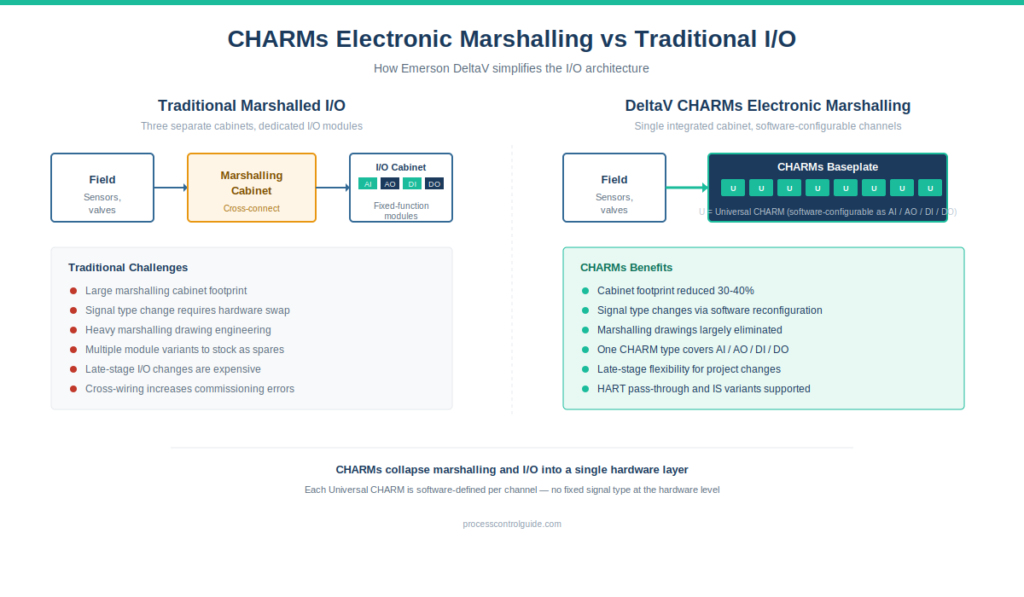
In a traditional DCS I/O architecture, field signals are wired to a marshalling cabinet, then cross-connected to I/O modules in separate cabinets. The marshalling cabinet exists specifically to translate from field wiring to module wiring, and to provide a physical termination point that can be modified without touching the I/O modules.
CHARMs eliminates the separate marshalling cabinet. Each CHARM is a small electronic module that plugs into a CHARMs Baseplate, with the field wiring landing directly on the CHARM terminals. Each CHARM can be configured by software as AI, AO, DI, or DO — there’s no fixed signal type at the hardware level.
CHARMs characteristics:
- Universal channel configuration — software-defined as AI, AO, DI, or DO per channel
- HART pass-through — supports HART communication to smart field devices
- Intrinsically Safe variants — IS-rated CHARMs for hazardous area applications
- Redundant power supply — dual power feeds for fault tolerance
- Compact footprint — reduces cabinet space versus traditional marshalled I/O
- Tool-less installation — CHARMs plug in and out without specialized tools
Practical implications of electronic marshalling:
The CHARMs approach has several practical effects on project execution, drawn from Emerson’s published case studies and from practitioner reports:
- Late-stage signal changes — if a project changes an analog input to a digital input late in commissioning, the change is a software reconfiguration rather than a module swap and rewire
- Reduced engineering hours — the marshalling drawings that traditionally consumed substantial engineering effort are largely eliminated
- Cabinet footprint reduction — Emerson cites reductions of 30-40% versus traditional marshalled architectures
- Spares management — fewer module variants to stock, since one CHARM type handles multiple signal types
Comparison to Universal I/O and N-IO:
CHARMs predates and arguably pioneered the electronic marshalling concept that Honeywell later implemented as Universal I/O and Yokogawa as N-IO. All three approaches achieve similar architectural goals — software-configurable I/O without separate marshalling cabinets — but the implementation details differ.
From cross-vendor coordination experience, CHARMs has the most mature ecosystem given its longer time in the market, though Universal I/O and N-IO have closed the gap in recent product generations.
DeltaV Network — The Control Backbone
The DeltaV Network is Emerson’s control network — a redundant Ethernet-based backbone connecting controllers, workstations, and application stations.
DeltaV Network characteristics:
- Redundant by design — dual network paths with automatic failover
- Ethernet-based — runs over standard 100Mbps and gigabit Ethernet hardware
- Smart Switches — managed switches that handle traffic prioritization for control data
- Time synchronization — supports precision time protocols for sequence-of-events recording
- Topology flexibility — supports star, ring, and hybrid topologies depending on plant layout
How DeltaV Network redundancy works:
Each node (controller, workstation, application station) connects to both network paths through redundant network interfaces. Control data flows over both paths with automatic recovery if one path fails. The failover model is similar in principle to Honeywell’s FTE and Yokogawa’s V-net/IP, though the implementation specifics differ between vendors.
Network design considerations:
Based on Emerson’s documentation and practitioner consensus, key DeltaV Network design principles include:
- Physical path separation — redundant network cables should route through physically separate cable trays to avoid common-cause failures
- Power source diversity — switches on each redundant path should be powered from independent UPS sources
- VLAN segmentation — production control traffic should be segmented from engineering and remote access traffic for both security and performance
- Cybersecurity integration — modern DeltaV deployments implement IEC 62443 security zones with appropriate segmentation
Operator Workstations and the HMI Model
The operator-facing side of DeltaV consists of Operator Workstations, ProPlus stations, and Application Stations — each serving different roles in the operational hierarchy.
Types of DeltaV workstations:
- Operator Workstation (OWS) — the standard runtime HMI in control rooms. Full graphics, alarm management, trend display, full operator capability.
- ProPlus (Pro+) — combined engineering and operator workstation, typical in smaller plants where one station serves dual roles
- Application Station — hosts advanced applications such as historian, batch executive, advanced PID, and OPC servers
- Remote Operator Station — view-only or limited-control variants for supervision or specialty use
HMI design and ISA-101:
Modern DeltaV HMI deployments follow ISA-101 standards for high-performance HMI design — high-contrast displays, consistent color usage, information hierarchy, and standardized symbols. According to Emerson documentation, recent DeltaV releases include native ISA-101-aligned graphic libraries.
On legacy DeltaV installations, the HMI graphics often predate ISA-101 and require modernization during upgrade projects. This pattern is consistent across DCS platforms — legacy Experion HMIs, legacy CENTUM HMIs, and legacy DeltaV HMIs all typically need ISA-101 retrofitting on upgrade projects.
Real-time data flow:
When an operator interacts with a tag in the Operator Workstation, the request flows through the DeltaV Network to the controller hosting that tag, which returns the real-time value. Trend data flows from the Continuous Historian; alarm data flows from the alarm subsystem; configuration data flows from the engineering database.
This is broadly similar to how operator data flow works across DCS platforms, with vendor-specific implementation details.
ProfessionalPlus and DeltaV Engineering Tools
ProfessionalPlus is the central engineering workstation in DeltaV architecture — the system that holds the master configuration database, runs DeltaV Explorer for navigation, and provides Control Studio for function block configuration.
What ProfessionalPlus does:
- Master configuration database — single source of truth for all controller and HMI configuration
- DeltaV Explorer — hierarchical navigation of the entire DeltaV system
- Control Studio — graphical function block configuration environment
- User Manager — security and access control for engineering operations
- Database deployment — compiles and downloads configuration to controllers
- Online editing — supports controlled changes to running systems
DeltaV Control Studio:
Control Studio is where DeltaV engineers spend most of their configuration time. It provides drag-and-drop function block configuration similar in concept to Honeywell Control Builder and Yokogawa AD Suite, though each vendor’s tool has distinct interaction patterns and workflows.
Recipe Studio and ISA-88 batch:
For batch applications, DeltaV provides Recipe Studio — a native ISA-88 batch development environment. This is the area where DeltaV is generally considered the strongest among major DCS platforms. The batch state engine, recipe management, and equipment modeling are first-class architectural features rather than add-ons.
From practitioner consensus, this batch maturity is a major reason DeltaV dominates in pharmaceuticals and specialty chemicals where ISA-88 compliance is critical.
Comparative perspective:
I can’t claim ProfessionalPlus mastery — that requires years of daily use I haven’t had. From cross-vendor coordination, the consensus from engineers I’ve worked with is that ProfessionalPlus has a learning curve coming from Experion or CENTUM, but the underlying workflows map reasonably to those platforms.
DeltaV SIS — The Safety System Side
DeltaV SIS is Emerson’s Safety Instrumented System — a separate, certified, redundant logic solver that runs alongside DeltaV BPCS (Basic Process Control System). This is governed by IEC 61511, the process industry functional safety standard. The IEC functional safety portal is the authoritative reference for these requirements.
Architectural separation:
IEC 61511 requires architectural separation between control logic and safety logic. You cannot run normal process control and safety shutdown logic on the same controller. DeltaV addresses this through:
- Charm Smart Logic Solver (CSLS) — the safety-rated controller for DeltaV SIS
- SQ Plus controllers — safety-rated variants of the standard S-Series controllers
- Separate safety I/O — CHARMs variants rated for safety applications
- Common engineering environment — DeltaV SIS uses the same ProfessionalPlus tools as BPCS, with safety-specific extensions and security controls
SIL certification:
DeltaV SIS components are TÜV-certified to SIL 3. This is consistent with other major DCS vendors’ safety platforms — Honeywell Safety Manager, Yokogawa ProSafe-RS, ABB AC 800M HI, and Triconex all carry SIL 3 certifications.
Integrated but separate:
The DeltaV SIS philosophy is “integrated but separate” — safety logic executes on dedicated safety hardware, but the engineering tools and operator interface are unified with the BPCS. From comparative perspective, this is similar in concept to how Honeywell integrates Safety Manager with Experion or how Yokogawa integrates ProSafe-RS with CENTUM, though each vendor’s implementation differs.
Cause and effect matrices:
Like other SIS platforms, DeltaV SIS configures interlock logic as cause and effect matrices. These matrices are reviewed during HAZOP, validated during SIL assessment, tested during FAT, retested during SAT, and walked down during commissioning. This sequence is platform-independent — every SIS platform follows this validation workflow because IEC 61511 requires it.
DeltaV Architecture vs Other DCS Platforms
DeltaV has distinct characteristics versus competing DCS platforms. Here’s a vendor terminology comparison:
| Component | Emerson DeltaV | Honeywell Experion PKS | Yokogawa CENTUM VP | ABB 800xA | Siemens PCS 7 |
|---|---|---|---|---|---|
| Controller | M/S/P/PK Series | C300 (CEE) | FCS (proprietary OS) | AC 800M | AS (Automation Station) |
| Operator Station | Operator Workstation / ProPlus | Experion Station / Console | HIS (Human Interface Station) | Operator Workplace | OS (Operator Station) |
| Engineering | ProfessionalPlus / Control Studio | Control Builder / Configuration Studio | AD Suite | Engineering Workplace | ES (Engineering Station) |
| Network | DeltaV Network | FTE (Fault Tolerant Ethernet) | V-net/IP (Bus 1 + Bus 2) | Control Network | Industrial Ethernet |
| I/O | CHARMs / Classic I/O | Universal I/O / Series C | N-IO / FIO | S800 I/O | ET 200 |
| SIS | DeltaV SIS (CSLS / SQ Plus) | Safety Manager | ProSafe-RS | 800xA Safety | Siemens F-Systems |
Where DeltaV wins:
- CHARMs electronic marshalling — mature, well-established
- ISA-88 batch implementation — strongest in regulated industries
- AMS Suite integration for asset management — tight Emerson instrumentation alignment
- Pharmaceuticals and specialty chemicals dominance — installed base and ecosystem
- Flexible controller portfolio — scales from skid systems to large facilities
Where DeltaV has trade-offs:
- Software-centric philosophy means heavier reliance on Windows infrastructure than CENTUM’s proprietary OS approach
- Smaller installed base in oil and gas mega-projects compared to Experion in certain regions
- License model complexity — DeltaV licensing has many options across modules and applications
- Engineering culture differs from Honeywell and Yokogawa — engineers transitioning between platforms face a learning curve
For broader context on how DeltaV fits within the DCS landscape, see our What Is a DCS cornerstone guide. For closely comparable platforms from other vendors, see our Honeywell Experion PKS architecture guide and Yokogawa CENTUM VP architecture guide.
Common DeltaV Architecture Mistakes
The following mistakes are drawn from Emerson’s training literature, industry practitioner forums, and cross-vendor coordination experience — not from primary DeltaV operations.
Underestimating CHARMs commissioning effort. While CHARMs simplifies marshalling, the configuration database for CHARMs assignments still requires careful management. Practitioner consensus suggests teams sometimes underestimate the database management discipline required to fully realize CHARMs’ theoretical benefits.
Treating DeltaV SIS as a software add-on. DeltaV SIS is its own engineering and validation discipline. Despite sharing tools with BPCS, the safety logic deserves separate engineering effort, dedicated FAT, and walk-down sequences distinct from process control commissioning.
Skipping DeltaV Network physical path separation. As with FTE in Experion and V-net/IP in CENTUM, redundant DeltaV Network paths must be physically separated. Sharing cable trays defeats the redundancy regardless of which vendor’s network is involved.
Insufficient batch design effort. DeltaV’s strongest area is batch, and projects sometimes default to DeltaV specifically for batch capability. But strong batch capability still requires disciplined ISA-88 design — equipment modeling, recipe procedures, and state engine definition. The tools enable good batch architecture; they don’t create it automatically.
Missing controller failover testing. Like every other DCS platform, redundant DeltaV controllers should be tested by pulling power and verifying failover during FAT and commissioning. Failover testing is not vendor-specific — it’s a fundamental DCS commissioning discipline.
Misconfiguring controller execution rates. Function block execution rates should match process dynamics. Fast loops on slow scan are wasteful; slow loops on fast scan can be unsafe. This applies across all DCS platforms but is worth highlighting for DeltaV given its flexibility.
Ignoring cybersecurity from day one. Modern DeltaV is increasingly network-connected. IEC 62443 compliance — network segmentation, account management, patch management — must be designed in rather than bolted on.
Frequently Asked Questions
What is Emerson DeltaV used for?
Emerson DeltaV is used for process control in continuous and batch industrial processes — chemicals, specialty chemicals, pharmaceuticals, life sciences, oil and gas, refining, food and beverage, and pulp and paper.
DeltaV has particularly strong adoption in pharmaceuticals and specialty chemicals where ISA-88 batch capability and Emerson’s broader instrumentation ecosystem (Rosemount, Fisher, Micro Motion) create a tightly integrated solution.
For the complete practitioner treatment of how DeltaV and other major DCS platforms apply to pharmaceutical manufacturing — including FDA 21 CFR Part 11 compliance, EU Annex 11, the GAMP 5 validation V-model lifecycle, ISA-88 batch control hierarchy, electronic batch records, and the reasons DeltaV is one of the two leading pharmaceutical DCS platforms — see our DCS in Pharmaceutical guide.
What is CHARMs in DeltaV?
CHARMs (Characterization Modules) are Emerson’s electronic marshalling I/O platform. Each CHARM is a small module that plugs into a baseplate, with field wiring landing directly on the CHARM terminals.
Each terminal can be software-configured as analog input, analog output, digital input, or digital output — eliminating the need for fixed-function I/O modules and separate marshalling cabinets. CHARMs reduces cabinet footprint and provides late-stage flexibility for signal type changes.
What are the DeltaV controller series?
DeltaV supports multiple controller series: M-Series (legacy, still supported), S-Series (current modern — SX, SD Plus, SQ Plus), P-Series (compact for skid and OEM applications), and PK Flex (Ethernet-native modern).
S-Series is the most common in current new installations. SQ Plus is the safety-rated variant used for DeltaV SIS applications.
What is the DeltaV Network?
The DeltaV Network is Emerson’s redundant Ethernet-based control network connecting controllers, operator workstations, application stations, and engineering workstations.
It runs over redundant Ethernet paths with automatic failover, similar in concept to Honeywell’s FTE and Yokogawa’s V-net/IP. Modern DeltaV deployments support gigabit Ethernet with Smart Switch traffic prioritization for control data.
What is DeltaV SIS?
DeltaV SIS is Emerson’s Safety Instrumented System — a separate, TÜV-certified SIL 3 logic solver that runs alongside DeltaV BPCS. The CSLS (Charm Smart Logic Solver) and SQ Plus controllers provide the safety-rated execution platform.
DeltaV SIS uses the same ProfessionalPlus engineering tools as BPCS, with safety-specific extensions and security controls, while maintaining the architectural separation that IEC 61511 requires.
How does DeltaV compare to Honeywell Experion PKS?
Both are mature, full-featured DCS platforms with overlapping but distinct strengths. DeltaV uses M/S/P/PK controllers, CHARMs I/O, DeltaV Network, and DeltaV SIS. Experion uses C300 controllers, Universal I/O, FTE, and Safety Manager.
Emerson emphasizes batch capability and electronic marshalling maturity; Honeywell emphasizes unified platform integration and large-scale continuous process projects. Selection often depends on industry fit, installed base, and regional preferences.
What is ProfessionalPlus in DeltaV?
ProfessionalPlus is the central engineering workstation in DeltaV architecture. It holds the master configuration database, runs DeltaV Explorer for hierarchical system navigation, and provides Control Studio for function block configuration.
ProfessionalPlus is where DeltaV engineers build control logic, manage tag databases, deploy configurations to controllers, and perform online edits during commissioning.
Is Emerson DeltaV still relevant in 2026?
Yes. Emerson continues active development of DeltaV, with current trends including PK Flex Ethernet-native controllers, expanded cloud connectivity, edge analytics, IEC 62443 cybersecurity compliance, and tighter AMS Suite integration.
DeltaV remains the dominant platform in pharmaceuticals and specialty chemicals and continues to compete strongly with Honeywell Experion PKS and Yokogawa CENTUM VP in the broader process industries.
Conclusion
The Emerson DeltaV architecture is built on a distinctive philosophy — electronic marshalling via CHARMs, native ISA-88 batch capability, and a scalable controller portfolio spanning skid systems to large facilities.
The architecture has evolved over decades from earlier DeltaV generations and continues to evolve with PK Flex Ethernet-native controllers, cloud connectivity, and cybersecurity integration.
I haven’t been a primary DeltaV practitioner, so my honest assessment is comparative rather than experiential. From cross-vendor coordination and research-grounded study, DeltaV occupies a meaningful niche — particularly strong in batch-dominated industries where its ISA-88 capabilities outperform some competitors. The CHARMs electronic marshalling concept genuinely simplified DCS I/O architecture and has influenced subsequent platform designs from competitors.
If you’re evaluating DeltaV for a project, study the architecture carefully and consider visiting reference installations. If you’re working on an existing DeltaV deployment, understanding the controller series, CHARMs, DeltaV Network, and ProfessionalPlus foundations is essential to effective troubleshooting and engineering.
For broader DCS context, see the What Is a DCS cornerstone guide. For direct comparisons with closely competing platforms, see our Honeywell Experion PKS architecture guide and Yokogawa CENTUM VP architecture guide.
For the broader architectural decision — how DeltaV fits alongside SCADA and PLC architectures on real industrial operations, including the selection decision framework for partitioning scope across all three — see our DCS vs SCADA vs PLC capstone guide
About the Author
Daniel Reed is an Instrument and Controls Engineer with 14+ years of oil and gas EPC experience across onshore and offshore projects in Asia and Africa. He currently works as a client-side I&C completion engineer on a large oil and gas mega-project in Asia, where he has been involved with Honeywell Experion PKS and Safety Manager since 2018.
His earlier work covered Yokogawa CENTUM and Triconex SIS on an offshore brownfield in Africa (2015-2018), and Yokogawa CENTUM and ProSafe-RS on a gas-to-liquids facility in Africa. His focus is engineering deliverable review, control and safety system commissioning, HAZOP/SIL/SIF participation, FAT/SAT execution, and vendor coordination across Honeywell, Yokogawa, Triconex, Allen-Bradley, and Siemens platforms.