
The first time I had to draw the architectural line between DCS and SCADA was on a midstream gas project I worked on early in my career. The processing plant itself — gas treatment, dehydration, compression — was clearly DCS territory. Yokogawa CENTUM running the continuous process, integrated safety system, redundant controllers, the works.
But the project also included a pipeline operations center 200 kilometers away, monitoring 15 remote tank farms, three booster stations, and 80 kilometers of pipeline with valves and instrumentation scattered along the route. That part wasn’t DCS — it was clearly SCADA.
The architectural decision wasn’t difficult once you saw the geographic scope. The DCS handled the single plant where everything was within walking distance of the central control room. The SCADA handled the geographically distributed assets where communication had to traverse leased lines, microwave links, and eventually cellular and satellite. The DCS engineer didn’t worry about telemetry. The SCADA engineer didn’t worry about real-time loop control. Two different problems, two different tools.
That experience clarified something the DCS vs SCADA articles online often blur: these aren’t competing solutions to the same problem. They’re complementary architectures designed for fundamentally different applications. DCS is for a single facility with everything wired back to one central control room. SCADA is for geographically distributed assets that need supervisory monitoring and control over wide-area communications.
This guide walks through the DCS vs SCADA question from the perspective of an engineer who has worked extensively on both sides. I’ll cover the real architectural difference, when each is the right answer, the modern hybrid pattern where both coexist, and the practitioner realities of how SCADA actually works in production.
If you’ve read our What Is a DCS cornerstone guide and our DCS vs PLC guide, this article completes the three-way comparison of the major industrial control architectures.
TL;DR — Quick Answer: DCS vs SCADA
The fundamental difference between DCS vs SCADA is geographic scope and architectural intent. A DCS (Distributed Control System) is designed for continuous process control within a single facility, with all controllers, I/O, and operator stations connected via redundant high-speed networks inside the plant boundary. A SCADA (Supervisory Control and Data Acquisition) system is designed for geographically distributed assets — pipelines, water networks, electrical grids, tank farms — where remote stations communicate with a central control room over wide-area communications.
DCS prioritizes:
- Continuous real-time control within a single plant
- Tight integration between controllers, HMI, historian, and safety systems
- Deterministic communication with millisecond-level response times
- Vendor-integrated platform designed to work together
- 25-30 year lifecycle support with one primary vendor
SCADA prioritizes:
- Geographic distribution across kilometers or thousands of kilometers
- Reliable communication over leased lines, radio, cellular, or satellite
- Polled or report-by-exception data collection rather than continuous high-speed control
- Multi-vendor flexibility with PLCs and RTUs at remote sites
- Supervisory monitoring and control with operators taking action on alarms
The DCS vs SCADA question rarely involves an either/or decision on real projects. A pipeline operator typically has DCS at each pumping station or compressor station (in-plant control) AND SCADA spanning the entire pipeline network (operations center supervising all stations). Both architectures coexist with appropriate roles.
Major DCS platforms include Honeywell Experion PKS, Yokogawa CENTUM VP, Emerson DeltaV. Major SCADA platforms include Wonderware (now AVEVA), GE iFIX/CIMPLICITY, Inductive Automation Ignition, Schneider Citect, Siemens WinCC, and Rockwell FactoryTalk View SE.
What You Will Learn
This guide covers DCS vs SCADA at working-engineer depth:
- The real architectural difference between DCS and SCADA (geographic scope, not technology)
- How each evolved historically and why they emerged for different problems
- The 10 key technical differences engineers should understand
- How SCADA architecture actually works (RTUs, PLCs, telemetry, polling)
- When DCS is the right architectural choice
- When SCADA is the right architectural choice
- The standard hybrid pattern: DCS inside the fence, SCADA across the network
- Honest cost and complexity comparison
- Common DCS vs SCADA selection mistakes I’ve seen
The Real Architectural Difference — Geographic Scope
Most DCS vs SCADA articles online focus on superficial technical differences — scan time, control loop performance, communication protocols. The real difference is more fundamental: DCS is for one plant, SCADA is for many sites.
A DCS lives inside the fence.
A DCS controls a single industrial facility where everything is physically connected within the plant boundary. Field instruments wire to I/O modules. I/O modules connect to controllers. Controllers communicate with operator stations over a redundant control network. Everything is high-bandwidth, deterministic, and tightly integrated. The DCS engineer assumes wired connections of known length and reliable power.
A refinery, gas processing plant, petrochemical complex, power station, or pharmaceutical facility is a DCS environment. The plant exists in one place. The operators sit in one control room. The infrastructure supports high-speed real-time communication.
A SCADA lives across the network.
A SCADA system supervises multiple sites distributed across geographic distances that range from a few kilometers to thousands of kilometers. Each remote site has its own local control (typically a PLC or RTU). The SCADA system polls those remote sites over wide-area communications — leased lines, microwave links, cellular, satellite, or modern Ethernet/IP over MPLS networks.
A pipeline network, water distribution system, electrical transmission grid, oil and gas gathering system, or remote well-field monitoring system is a SCADA environment. The assets exist at multiple locations. Operators in one control center supervise them all. Communication latency, bandwidth, and reliability constraints shape every architectural decision.
Why the geographic scope matters.
The DCS vs SCADA difference is most visible in how each architecture handles three things:
- Communication latency — DCS assumes millisecond-level deterministic communication; SCADA tolerates seconds-to-minutes polling cycles
- Local autonomy — DCS controllers depend on the central network; SCADA remote sites operate autonomously when communications drop
- Operator interaction model — DCS operators continuously monitor and adjust the live process; SCADA operators respond to alarms and exceptions from distributed sites
These differences flow from the geographic reality of each application. A DCS engineer designs for sub-second response times because that’s what process control needs. A SCADA engineer designs for communication interruptions because that’s what pipelines and remote sites experience.
For broader DCS context, see our What Is a DCS cornerstone guide.
A Brief Honest History
DCS vs SCADA history follows from the fact that they emerged from different problem spaces in roughly the same era but evolved on parallel tracks for different applications.
DCS history.
The first commercial DCS — Honeywell TDC2000 in 1975, Yokogawa CENTUM in 1975 — was designed to replace analog panel-based control rooms in process plants. The problem was that continuous process control was being done with pneumatic and electronic analog controllers in panels that filled entire rooms. Operators tuned dozens of single-loop controllers by hand. The DCS introduced digital controllers, networked communications, and CRT-based operator interfaces — all designed for a single facility with everything physically connected.
For the next 50 years, DCS evolved to handle larger plants, more I/O, integrated safety systems, advanced control, and enterprise integration. But it stayed within the fence. A DCS doesn’t make sense for geographically distributed assets because its architecture assumes the local control network’s bandwidth and reliability.
SCADA history.
SCADA evolved from telemetry systems used in electrical utilities, water systems, and oil and gas pipelines starting in the 1960s. The problem was different: how do you monitor and control assets that are tens or hundreds of kilometers away from where the operator sits? The early answer was dedicated telemetry circuits — copper pairs, microwave links, radio — sending limited information from remote sites to a central station.
By the 1980s, SCADA had become more sophisticated. Computer-based master stations could display graphical representations of geographically distributed networks. RTUs (Remote Terminal Units) at field sites collected local data and reported it on a schedule or by exception. Operators could see the state of an entire pipeline network on a single screen and send control commands to remote valves and pumps.
The modern SCADA platform — Wonderware (now AVEVA), iFIX, Ignition, Citect — descends from this telemetry heritage but has expanded into territory that overlaps with DCS in some applications. The boundary between DCS vs SCADA has blurred for some plant-scale applications, but the fundamental geographic scope distinction remains.
For broader history, see the Wikipedia overview of SCADA systems and distributed control systems.
The 10 Key Technical Differences
Detailed DCS vs SCADA comparison of the differences that matter in practice:
| # | Aspect | DCS | SCADA |
|---|---|---|---|
| 1 | Geographic scope | Single facility, inside the fence | Wide area, multiple distributed sites |
| 2 | Original design intent | Continuous process control | Supervisory monitoring of distributed assets |
| 3 | Communication | Redundant deterministic LAN | Polled or report-by-exception over WAN |
| 4 | Response time | 100-500ms typical | Seconds to minutes typical |
| 5 | Local autonomy | Controllers depend on plant network | RTUs/PLCs run autonomously when comms drop |
| 6 | Operator interaction | Continuous live process monitoring | Exception-based supervisory response |
| 7 | Field hardware | Vendor-integrated I/O modules | RTUs and PLCs from various vendors |
| 8 | Communication protocols | FTE, V-net/IP, DeltaV Network | DNP3, IEC 60870-5, Modbus TCP/IP |
| 9 | Vendor integration | Single vendor full stack | Multi-vendor flexibility expected |
| 10 | Typical I/O scale | 2,000-50,000+ in one facility | Hundreds to thousands across many sites |
Each of these differences flows from the underlying geographic scope distinction.
The communication difference is illustrative.
A DCS operator sees process values updating multiple times per second because the controllers are pushing data over a deterministic high-speed network within the plant. A SCADA operator typically sees remote sites updating every few seconds to a few minutes because the master station polls remote sites in sequence over communication channels that have limited bandwidth and may be shared with many other sites.
For an oil and gas pipeline with 50 remote stations connected via cellular or radio, polling each station’s full data set every second isn’t physically possible. SCADA architectures accept this and use polling schedules, report-by-exception communications, and local autonomy at remote sites to make distributed monitoring practical.
For deeper PLC context related to SCADA RTU/PLC field hardware, see our sister site controlsystemguide.com.
How SCADA Architecture Actually Works
A SCADA architecture has several distinct layers that work together across geographic distances.
The field layer — RTUs and PLCs.
At each remote site, local hardware handles the immediate field interface. Traditionally this was an RTU (Remote Terminal Unit), a purpose-built device for telemetry. Modern SCADA systems increasingly use PLCs that look more like industrial controllers but are configured for SCADA’s polling-based communication model.
RTUs and PLCs at remote sites do three things: read field instrumentation, execute local control logic (closing valves on alarms, starting pumps on demand), and report status back to the SCADA master station when polled or when significant changes occur.
The communications layer.
This is where SCADA differs most from DCS. Communication between the master station and remote sites traverses one of several technologies:
- Leased lines or fiber (most reliable, highest cost)
- Microwave links (high bandwidth, line-of-sight required)
- Cellular (3G/4G/5G, increasingly common, depends on carrier coverage)
- Satellite (for the most remote sites, high latency, expensive)
- VHF/UHF radio (legacy for short-distance applications)
- Ethernet over MPLS (modern enterprise networks)
Each remote site has its own modem, router, or telemetry radio. The communications layer often becomes the most challenging part of SCADA engineering because bandwidth, latency, and reliability vary across sites.
The master station layer.
The central control room runs the SCADA master software (Wonderware, iFIX, Ignition, Citect, etc.). The master polls remote sites on a schedule, archives historical data, displays operator graphics, manages alarms, and accepts operator commands. The master station typically runs on standard servers with redundancy options, unlike DCS which uses purpose-built control hardware.
The HMI layer.
Operators interact with the SCADA master through HMI screens that typically display geographic representations of the network — a map of the pipeline showing pump stations as icons, valves as symbols, current flow rates and pressures at each location. This differs from DCS HMI, which typically displays process flow diagrams of equipment within a single facility.
The data layer.
SCADA systems include historians for long-term data archiving, often integrated with enterprise systems for reporting and compliance. The historian load is different from DCS because SCADA collects less frequent samples from many sites, while DCS collects very frequent samples from fewer points.
This architecture is fundamentally different from DCS even though both manage process variables and operator interfaces. The differences flow from the geographic scope and communication constraints inherent to SCADA applications.
When DCS Is the Right Answer
DCS is the right architectural choice when several conditions are met:
- The application is a single facility where all assets are within walking distance of the control room
- The process is continuous and runs 24/7 between turnarounds
- Real-time response is needed for control loops (sub-second)
- High I/O density in one location (2,000+ tags, often 10,000+)
- Integrated safety system is required
- Tight vendor integration is valued over multi-vendor flexibility
- The plant operations team expects continuous live monitoring of the process
Industries that are predominantly DCS:
- Oil and gas processing facilities (single plant: separation, treatment, compression)
- Refining and petrochemical complexes
- Power generation stations (combined cycle, nuclear, large fossil)
- Chemical and pharmaceutical batch and continuous plants
- Pulp and paper mills
- LNG liquefaction trains and regasification terminals
On the oil and gas mega-project in Asia where I currently work, the BPCS is Honeywell Experion PKS handling continuous process control across the entire facility. Everything is wired back to a central control building. The operators monitor live process values updating multiple times per second. This is classic DCS territory in the DCS vs SCADA architectural decision.
When SCADA Is the Right Answer
SCADA is the right architectural choice when:
- The application spans geographic distances beyond a single facility
- Multiple remote sites need supervisory monitoring from a central location
- Wide-area communications are required (leased lines, cellular, satellite, radio)
- Local autonomy at remote sites is needed when communications drop
- Operator interaction is exception-based rather than continuous
- Multi-vendor field hardware must be supported (mixed RTU and PLC vendors)
- Update rates of seconds to minutes are acceptable for the application
Industries that are predominantly SCADA:
- Oil and gas pipelines (transmission and gathering)
- Water and wastewater distribution networks (municipal)
- Electrical transmission and distribution grids
- Natural gas distribution networks
- Remote oilfield and gas field monitoring (wellpads, gathering systems)
- Tank farm and terminal operations spanning multiple sites
- District heating and cooling networks
- Renewable energy networks (wind farms, distributed solar)
On the midstream gas project I mentioned earlier, the SCADA system covered 80 kilometers of pipeline with 15 tank farms and three booster stations — clearly SCADA territory because the assets were geographically distributed and required wide-area communications.
The Modern Hybrid — DCS Inside the Fence, SCADA Outside
Most real industrial operations involve both DCS and SCADA, and the DCS vs SCADA decision becomes a question of where each fits rather than choosing one — DCS at each facility for in-plant control, SCADA across the network for supervisory monitoring of multiple facilities. This hybrid is the standard pattern for any operator with multiple facilities or geographically distributed assets.
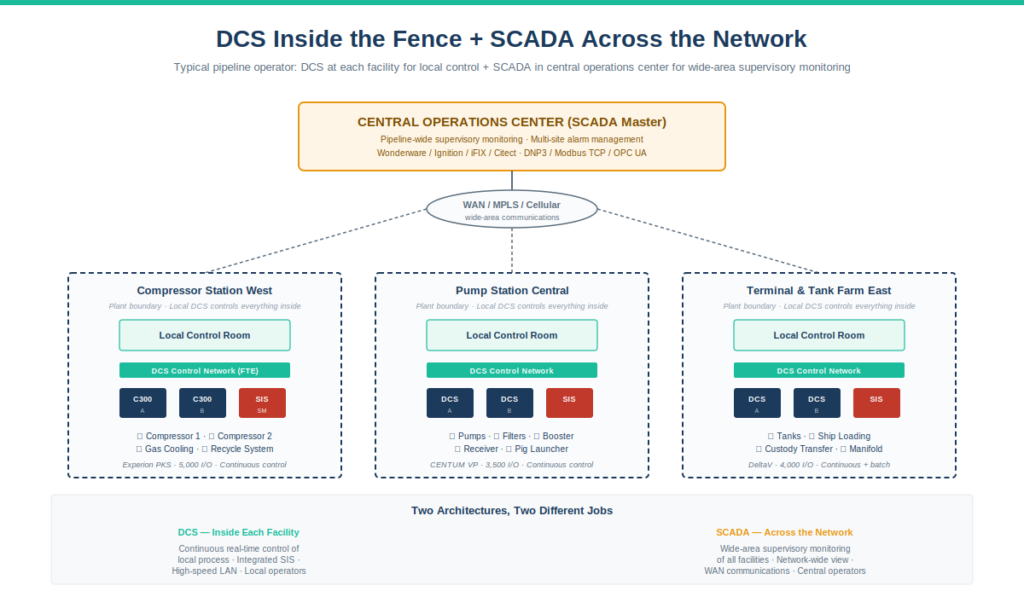
Typical hybrid architecture for a pipeline operator:
- DCS at each compressor station — Honeywell Experion PKS or equivalent running the local continuous process control, integrated with the local safety system
- DCS at each pumping station — same pattern
- Local SCADA at each terminal — managing tank farm operations
- Wide-area SCADA in the pipeline operations center — supervising all facilities across the network, integrating data from each local DCS, providing pipeline-wide operator view
- Communications backbone — connecting all sites via fiber, microwave, cellular, or combinations
The DCS handles what it does best: tight local control, fast response, integrated safety. The SCADA handles what it does best: wide-area supervisory monitoring, distributed operator interaction, multi-site coordination. Both architectures contribute to the overall operation with appropriate roles.
Typical hybrid architecture for an oil and gas operator with offshore platforms:
- DCS on each offshore platform — managing the platform’s continuous process (separation, gas treatment, water injection, oil export)
- DCS at the onshore receiving terminal — managing the terminal’s process operations
- SCADA at the central operations control center — supervising all offshore platforms and onshore terminals, integrating production data, providing executive view of total operations
- Production accounting and reporting systems — feeding from both DCS and SCADA into enterprise systems
This pattern repeats across the oil and gas industry. The DCS vs SCADA question isn’t either/or for operators of this scale — it’s both, in their right places.
For broader hybrid architecture context (DCS + PLC), see our DCS vs PLC guide.
Honest Cost Comparison
The DCS vs SCADA cost difference is significant but reflects fundamentally different scope, not directly comparable functions.
DCS cost structure.
A DCS for a process facility includes redundant controllers, integrated I/O, multiple operator workstations, engineering workstation, historian, safety system, and vendor engineering services. CAPEX for a 2,000-I/O DCS typically runs $500K-$2M+ depending on the platform, redundancy options, and engineering scope. CAPEX for a 10,000-I/O complex DCS can exceed $10M.
The DCS cost reflects the integrated platform — everything from controllers to engineering tools is included. The vendor relationship spans 25-30 years with planned migration support.
SCADA cost structure.
SCADA cost depends heavily on the geographic scope. The master station software (Wonderware, Ignition, iFIX) typically costs $20K-$200K depending on tag count and licensing model. RTUs or PLCs at remote sites cost $2K-$20K each depending on I/O count and ruggedization. Communications infrastructure (radios, cellular modems, leased lines) can be the dominant cost item for geographically large networks.
A pipeline SCADA covering 50 remote sites might have:
- Master station software: $100K
- RTUs/PLCs (50 sites): $300K
- Communications infrastructure: $200K-$500K
- Engineering services: $300K-$500K
- Total: roughly $1M-$1.5M for the SCADA scope
The DCS and SCADA costs aren’t directly comparable because they’re for different scopes. A facility’s DCS controls one plant. A pipeline’s SCADA monitors 50 distributed assets. Both serve their purposes.
For broader project engineering context, ISA standards provide guidance on control system selection.
Common Selection Mistakes I’ve Seen
After working on industrial control projects with both DCS and SCADA components, here are the recurring DCS vs SCADA selection mistakes:
Trying to use SCADA for in-plant continuous process control. SCADA software wasn’t designed for sub-second deterministic control of continuous processes. Some PLC + SCADA combinations can do it, especially modern PAC platforms, but using traditional SCADA architectures for what should be DCS work typically produces inadequate control performance.
Trying to use DCS for geographically distributed assets. DCS architectures assume reliable high-speed local communications. Trying to extend a DCS across kilometers of pipeline or to multiple remote sites stretches the architecture beyond its design intent. The communication latency, reliability, and bandwidth issues make this approach problematic.
Forgetting communications engineering on SCADA projects. The SCADA master and remote sites are the visible parts, but communications between them often becomes the project’s most complex element. Bandwidth, latency, reliability, and security across leased lines, cellular, and satellite all need engineering attention. Many SCADA project issues trace back to inadequate communications planning.
Selecting SCADA platform based on master station features alone. The master station is what gets demonstrated in sales meetings, but RTU/PLC support, driver libraries, communications protocols, and field engineering quality matter more for project success. A SCADA platform with beautiful HMI screens but limited driver support for your field hardware will fail in implementation.
Underestimating SCADA cybersecurity. SCADA networks span wide areas with multiple entry points (cellular, internet-connected modems, leased lines). Cybersecurity for SCADA is typically more challenging than for DCS because the attack surface is larger and remote sites have less physical security.
Treating SCADA as “just the HMI on top of PLCs.” Modern SCADA is more sophisticated — alarm management, historian, advanced graphics, mobile access, integration with enterprise systems. Building a custom SCADA from scratch on top of generic PLCs typically produces inferior results compared to using a proven SCADA platform.
Mixing DCS and SCADA terminology in cross-team meetings. When the in-plant DCS team and the pipeline SCADA team discuss integration, terminology confusion creates real problems. “Tag,” “alarm,” “trend,” and “graphic” can mean different things in each environment. Establish vocabulary explicitly during integration projects.
Selecting based on initial CAPEX without considering lifecycle. Both DCS and SCADA platforms have multi-decade lifecycles. The initial software/hardware cost is one input among many — vendor support, migration paths, training, spare parts logistics, and security patching all matter over 20-30 years.
Frequently Asked Questions
What is the main difference between DCS and SCADA?
The main difference between DCS vs SCADA is geographic scope and architectural intent. DCS is designed for continuous process control within a single facility with high-speed deterministic communications. SCADA is designed for supervisory monitoring of geographically distributed assets over wide-area communications. DCS lives inside the fence; SCADA lives across the network.
Can SCADA replace a DCS?
Generally no, for continuous process control applications. SCADA architectures aren’t designed for sub-second deterministic control of continuous processes within a single facility. Modern PLC + SCADA combinations can handle some process applications, but for large continuous facilities with thousands of control loops and integrated safety systems, traditional DCS remains the right architecture.
Can DCS replace SCADA?
No, for geographically distributed applications. DCS architectures assume reliable high-speed local communications and don’t extend well across geographic distances. A pipeline network or distributed water system needs SCADA’s wide-area architecture, not DCS.
Which is more expensive — DCS or SCADA?
DCS typically has higher cost per I/O point and per facility, reflecting the integrated platform and vendor relationship. SCADA has lower cost per tag but can have substantial communications infrastructure costs for geographically large networks. The cost comparison isn’t direct because they serve different scopes.
What is the difference between SCADA and HMI?
HMI (Human-Machine Interface) is one component of a SCADA system — the operator screens. SCADA is the broader architecture including HMI plus data acquisition from remote sites, alarm management, historian, and communications infrastructure. An HMI alone doesn’t make a SCADA system; it’s just the visualization layer.
What is the difference between SCADA and PLC?
PLCs are field-level controllers that execute logic. SCADA is the supervisory layer above PLCs that collects data from multiple PLCs and RTUs, displays it to operators, manages alarms, and archives data. PLC + SCADA is a common combination — PLCs do local control, SCADA does supervisory monitoring across multiple sites.
Can DCS and SCADA work together?
Yes — most large industrial operators use both. DCS at each facility handles local in-plant control. SCADA spanning multiple facilities provides supervisory monitoring from a central operations center. The hybrid pattern is standard for pipeline operators, multi-site oil and gas operators, water utilities, and electrical grid operators.
What protocols do SCADA systems use?
Common SCADA protocols include DNP3 (popular in electrical utilities), IEC 60870-5 (electrical and water utilities), Modbus TCP/IP (general industrial), OPC UA (modern systems), and various vendor-specific protocols. Modern SCADA platforms support multiple protocols simultaneously to accommodate mixed field hardware.
When should I use DCS vs SCADA for my project?
Use DCS for continuous process control within a single facility — refineries, gas plants, petrochemical complexes, power stations, pharmaceutical plants. Use SCADA for geographically distributed assets — pipelines, water networks, electrical grids, multi-site oil and gas operations. Use both together when you have multiple facilities (DCS at each, SCADA across the network).
Conclusion
The DCS vs SCADA question is genuinely about different problems, not competing solutions to the same problem. DCS handles continuous process control within a single facility with high-speed deterministic communications. SCADA handles supervisory monitoring of geographically distributed assets over wide-area communications. Each excels at what the other isn’t designed for.
The most important practical truths about DCS vs SCADA:
- Geographic scope is the defining architectural difference, not the technology details
- DCS lives inside the fence at a single facility; SCADA lives across the network at multiple sites
- The hybrid pattern (DCS inside, SCADA outside) is standard for multi-facility operators
- Communications engineering is the most challenging aspect of SCADA projects
- Selection based on initial CAPEX without lifecycle consideration is the most common mistake
On every multi-facility oil and gas operation I’ve seen, both architectures coexist with appropriate roles. The DCS at each compressor station, gas plant, or processing facility handles local continuous control. The SCADA at the central operations center provides network-wide supervisory monitoring. Operators in the local control rooms see fast detailed process data. Operators in the central operations center see the network-wide picture. Both perspectives matter.
If you’re approaching a control system architecture decision involving both in-plant operations and distributed assets, resist the temptation to force one architecture across the entire scope. Use DCS where DCS fits. Use SCADA where SCADA fits. Plan the integration between them carefully. Engage both teams in interface design. And recognize that the modern industrial landscape often calls for hybrid architectures combining the strengths of both DCS and SCADA.
For broader DCS context, see our What Is a DCS cornerstone guide. For the DCS vs PLC comparison, see our DCS vs PLC guide. For PLC-specific resources covering programming and SCADA integration, see our sister site controlsystemguide.com. For vendor-specific DCS architecture deep-dives, see our Honeywell Experion PKS architecture guide, Yokogawa CENTUM VP architecture guide, and Emerson DeltaV architecture guide.
For the complete three-way capstone comparison combining this DCS vs SCADA analysis with PLC — including the selection decision framework and the hybrid pattern partitioning scope across all three architectures — see our DCS vs SCADA vs PLC capstone guide.
About the Author
Daniel Reed is an Instrument and Controls Engineer with 14+ years of oil and gas EPC experience across onshore and offshore projects in Asia and Africa. He currently works as a client-side I&C completion engineer on a large oil and gas mega-project in Asia, where he has been involved with Honeywell Experion PKS and Safety Manager since 2018.
His earlier work covered Yokogawa CENTUM and Triconex SIS on an offshore brownfield in Africa (2015-2018), and Yokogawa CENTUM and ProSafe-RS on a gas-to-liquids facility in Africa. His focus is engineering deliverable review, control and safety system commissioning, HAZOP/SIL/SIF participation, FAT/SAT execution, loop tuning across multiple DCS platforms, and vendor coordination across Honeywell, Yokogawa, Triconex, Allen-Bradley, and Siemens platforms.